
Although several disparate sources have described specific events in the life of Boleslaw Cybis either in print or online, this is the first time that a complete and detailed single timeline has been available online. I have constructed it from multiple sources in Poland and in the USA.
1895 – We begin with a discrepancy in the date of Boleslaw Jaroslav Cybis’ birth! A Polish source (2002 major art gallery exhibit catalog) claims that it was June 6, 1895 on the Massandra estate in the Crimea which was then part of Ukraine. Another source says that he was born on July 23, 1895 in Wilno, Lithuania. His parents were Franciszek Ksawery and Mariana Osmolska Stanislawa. He was baptized on December 6, 1895 in the Roman Catholic parish at Simferopol. Boleslaw remains an only child.
 1901 – Boleslaw with mother Mariana Stanislawa Cybis.
1905 – Marja Tym is born in Human, Russia, on October 13, 1905. However, Boleslaw’s naturalization application says she was born in 1900, and her tombstone gives her birth year as 1906. Her parents were Jan Tym and Klementyna (Koszynska). Marja had at least two siblings: an older brother Casimir born on June 30, 1898; and a sister Alicja (Alicia) whose birth date is unknown. Casimir and his wife later emigrated to the USA but Alicja did not.
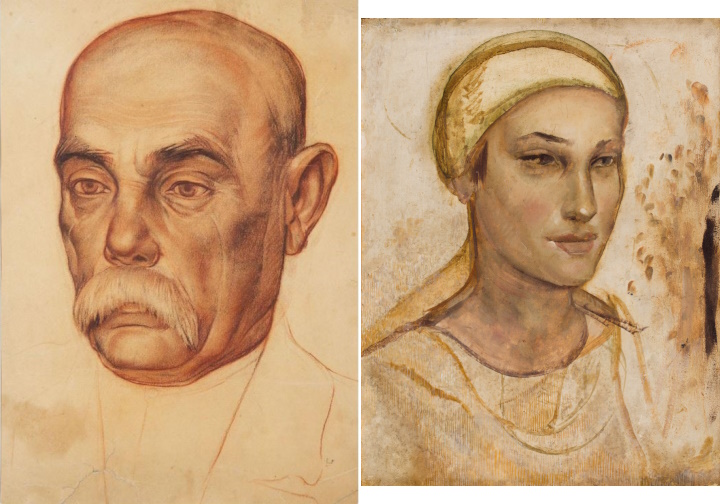 These portraits of Jan Tym and Alicja Tym were painted by Boleslaw Cybis, in Poland, during the 1930s.
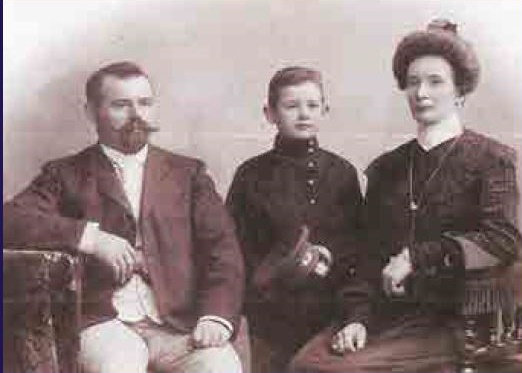 Bolesław Cybis is living with his parents in Grodno, a village about nine miles from the current Russia/Poland border. This family photo dates from 1905 or 1906.
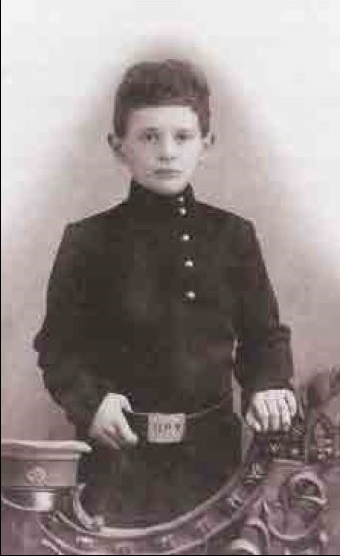 1906 – Bolesław Cybis as a student of the Vilnius Real School in 1906.
1910 – Boleslaw receives various athletic awards for gymnastic excellence at school. He spends summer vacations with his maternal aunt in Grodno. Boleslaw’s father was originally a merchant, and later became a building supervisor/architect. Because of this, the family’s residence changed several times.
1911 – The Cybis family moves to St. Petersburg, and Boleslaw attends a school run by Karl Maj. He gets into a bit of trouble, according to the school records, for “… unlawful departure from St. Petersburg during Easter holidays without permission of the director and without a ticket for holidays, as well as street smoking and false testimony about the students for smoking.”
1912 – The family leaves St. Petersburg in May and moves to Kharkiv, where they change their residence several times. From 1912-14 they resided in Apartment #5 in the Sumka building; then in 1915, at 39 Czernyszewska Street and 63 Sisternyna Street. His father’s office was at 32 Weternynarna Street where he had a telephone (which was unusual in those days.)
1915 – Boleslaw attends a private school run by a professor of the Georgi Burakov Institute of Technology.
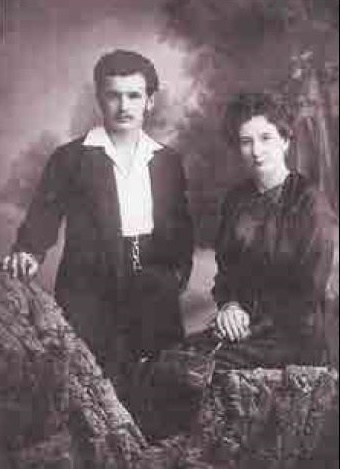 1915 – Boleslaw and his mother.
1916 – Boleslaw studies at the Kharkiv School of Fine Arts.
1917 – With six friends (Volodymyr Bobryckij, Volodymyr Djakow, Mykola Kalmykow, Mane Kac, Boris Kosarew, Mykola Mishchenko and Georgy Capok) he founds an artist’s group known as the “Association of Seven” (also called the “Union of Seven” or “Group of Seven”.) In this group Boleslaw begins to focus on sculpture.
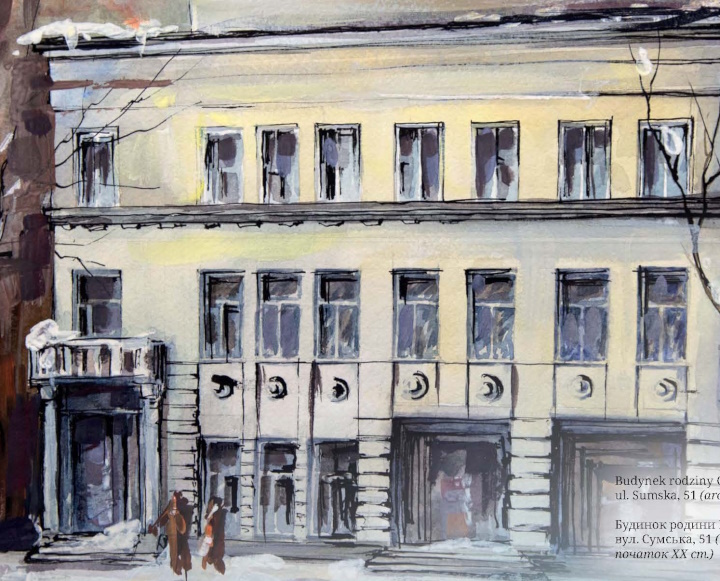 1918 – At his parents’ apartment at 39 Czernyszewska Street (artist conception above), his group – now with three new members – establishes an actual studio and publishes a printed collection of their works which is entitled Seven Plus Three. Boleslaw presents his first art exhibition and receives his first rating from critics. This is when his record as an artist begins. From May 7th to June 1st, in the halls of the Kharkiv School of Fine Arts, an exhibition of works takes place; Boleslaw exhibits four wood sculptures under the title Linden. A critic of the exhibit wrote, in part,
…The most interesting are the exhibits of the “Group of Seven” – Cybis, Kalmykow, Bobrytsky, and Kac. By way of analysis for them: The journey has already passed, and especially for Kalmykow and Cybis […] they could not themselves create anything, and probably none will create any more. However, fate will eventually assess the artists’ work.
In the art review magazine Kłosy, a critic writes “Among the reproductions, Cybis’s primitive canons (sculpture on a tree) are distinguished”. Unfortunately, these works, as well as other early ones, have been lost.
The group often contributes to Kłosy by publishing images of their works within its pages. The November issue contains four Cybis sketches under a Cityscapes heading. They are titled At the Third Hour of the Night, Syfilis, In the Hospital, and End. Cybis also takes a temporary job as a stage decorator at the Karkhiv City Theatre.
1919 – The group publishes The Collection of a New Studio, their second such effort. Cybis and Kalmykow illustrate the book Poetry of the Workers’ Blow. A reviewer comments that “Looking at the works of Cybis, one can make a claim that the artist is in a strong search for pure form and matter.”
The invasion and occupation of Kharkiv by Russia (the first such invasion of Ukraine; the second is ongoing as of this writing) resulted in the establishment of numerous concentration camps. Cybis is forced to flee the city on September 6th, traveling through Kherson in the Crimea on his way to the Middle East.
1920 – Having traveled through Theodosia (Greece), Cybis arrives in Constantinople (present-day Istanbul) on July 8th. He moves in with Russian artists Constantin Alajalov and Pavel Tchelitchev. Vlodymyr Bobritsky is also there.
1921-1922 – In Constantinople, Cybis ekes out a meager living of bread, olives and goats’ milk in exchange for sketching portraits in cafes, painting sidewalk advertisements for theatres, painting murals in nightclubs and cafes, painting and designing stage backdrops for the ballet, and fashioning clay pipes in ornate designs. One of his first paid jobs is a gigantic billboard advertising Nestles Chocolate. He also works for a time at a restaurant called ‘Strelna’. Because he often cannot afford to buy drawing paper, he sometimes uses both sides of a single sheet for his works.
1923 – Boleslaw returns to Warsaw in mid-July to live with his parents in their apartment at #12 Trzech Krzyzy Square, and takes a job at the ceramics factory owned by Andrzej Wojnacki and Kazimierz Czechowski. In September he accepts a position at the Warsaw Academy of Fine Arts as a lecturer. At this time the focus there is on fabrics (kilims and jacquards.)
1924 – Cybis studies painting in the studio of Prof. Tadeusz Pruszkowski and printmaking with Władysław Skoczylas. Those two later men organized the Brotherhood of Saint Luke which stressed mastery of the craft of painting. His first public exhibition is at an open-air display in Kazimierz Dolny which is located on the Vistula River.
1925 – Boleslaw marries Marja Tym on March 11, 1925. The ceremony takes place at the Church of the Holy Trinity in Warsaw; however, there were three churches by this name at the time and I have been unable to determine which it was. The original records from the parish priest still exist, and state:
On January 25, February 1, and February 8, 1925, three pre-wedding announcements were made about the intended marriage between Bolesław Jarosław Cybis, a bachelor, a painter residing in the parish of the Holy Trinity in Warsaw, and Maria Tym, a maid with her parents, living in the parish of Radziwiłł in the diocese of Lutsk-Żyto, and that no obstacles were detected.
The newlyweds move into an apartment located within the span of the Poniatowski Bridge where Boleslaw’s father works. During the December holidays, Boleslaw visits his friend Jan Stokowski’s home at Lowicz and becomes fascinated by the local costumes there; several of his paintings, and two modern Cybis Studio sculptures (The Bride and Birth at Lowicz), were based on them.
1927 – Thanks to financial contributions from their parents, the couple begins construction of a house and studio in Młociny, within the Bielany district near Warsaw and the Vistula River, on land that purchased from Count Tarnowski when he decided to break his farmland into parcels. Boleslaw and Marja bought three plots of land, and four adjacent plots were bought by other members of the Group of Seven. See this post for more information about this endeavor.
 1928 – The first exhibition of the Brotherhood of St Luke opens on February 4th to very positive reviews. Cybis paints three separate versions of his female nude titled Toilette. He also continues to work at the Wojnacki-Czechowksi ceramics factory part-time.
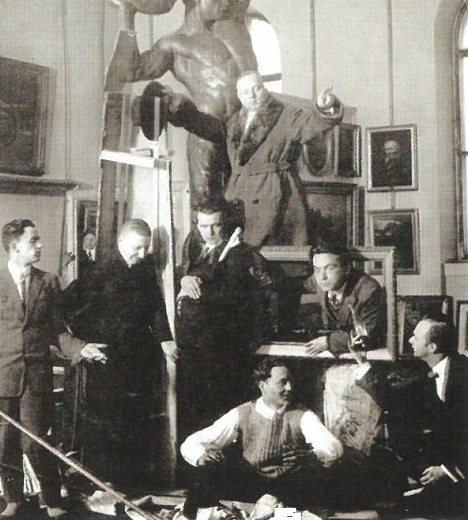 This photo shows Cybis among the other artists at the Warsaw Academy of Fine Arts in 1928.
 1929 – The Brotherhood of Saint Luke mounts its second exhibition and issues a catalog.
 The Cybis home and garden at Młociny is completed late this year.
1930 – Boleslaw again exhibits in a Brotherhood show in January, at the Society of the Friends of Fine Arts, in Krakow. Shortly afterward, he and Marja, along with fellow artist Jan Zamoyski, embark on a study/trip through Europe, starting in Italy (Rome, Florence, and Sicily.) They also go to Libya, where Boleslaw creates many sketches and drawings which he will translate into paintings later this year after they return to Poland.
1931 – In April, Marja Cybis exhibits several landscape drawings from her European journey.
1933 – Boleslaw Cybis visits the USA in order to exhibit several paintings at the Brooklyn Museum of Art, as well as at museums in Chicago, Dayton, and Pittsburgh. On November 12th, an exhibit of contemporary art is mounted in Moscow, where Cybis presents two paintings: Toilette and Porters.
1934 – Boleslaw is one of the artists chosen to create art for the interiors of the new Polish luxury liners Pilsudzki and Batory. These ships were intended to become “floating Polish art salons” and were worked on by a team of professors and students from the Warsaw Academy of Fine Arts. A rather sloppily-written 1936 article in Interior Decorator magazine, describing the newly launched ship, reports that the Batory’s American Bar had:
…wall decorations representing motives [sic] of exotic beauties from the islands of the Indies made ‘en relief’, chiseled, plated with oxidized silver and ‘patened’ [made to look old; probably a malapropism for patina’d]. The artist is Boleslaw Cybis, member of the St. Lucas [sic] brotherhood Guild.”
Also this year, Cybis exhibits his 1932 painting Consolation at the 19th Art Biennale in Venice.
1935 – The couple take a brief trip to the United States to exhibit art in several states, including Baltimore and San Francisco. Upon their return to Europe, Boleslaw takes part in an exhibition of Polish art at the Academy of Fine Arts in Berlin. He continues to work on the decorations for the Batory.
 1936 – Boleslaw and Jan Zamoyski paint a large fresco for the Military Institute in Warsaw, depicting King Boleslaw Tracing the Borders of West Poland on the Oder River. Cybis also paints Primavera. The Art Institute in Dayton, Ohio, purchases his painting The Bride.
 1937 – In April, Boleslaw and Marja go to Paris to work with Zofia and Adam Siemaszko on the plafond at the entrance to the World Exhibition (photo above; more information on that event can be found in this post.) The plafond is awarded a Grand Prix by the exhibit’s judges.
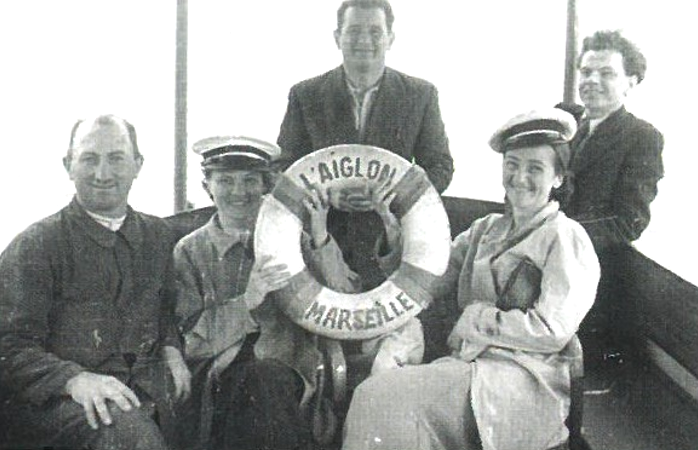 After the exhibit, both couples vacation together in Marseilles. (l-r: unknown man, Marja Cybis, Boleslaw Cybis, Zofia and Adam Siemaszko)
Later in the year, Boleslaw again visits America to show at a Carnegie Institute (Pittsburgh) exhibition. He is also formally appointed a Professor at the Academy of Fine Arts in Warsaw, where he specializes in fabrics and woodworking. Boleslaw again visits America to show at a Carnegie Institute (Pittsburgh) exhibition. In September he is offered a contract to lecture at the Academy of Fine Arts in Warsaw for their evening student program.
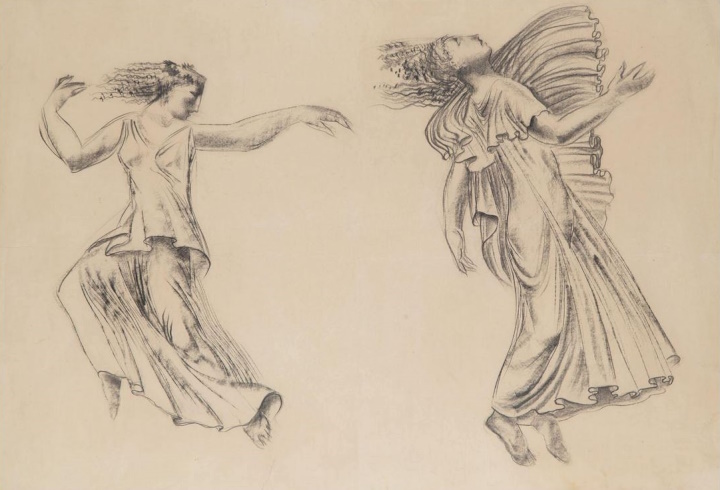 1938 – Boleslaw produces several sketches (seen in this post) for a painted ceiling, to be called ‘Polish Sky’, for a school founded by the Polish Educational Society in Gdansk. In May, The Brotherhood of Saint Luke is commissioned to paint historical murals at the Polish Pavilion for the upcoming 1939 World’s Fair in New York; see this post for an examination of that display. The finished murals are exhibited in December for a short time at the Institute for the Promotion of Art in Warsaw.
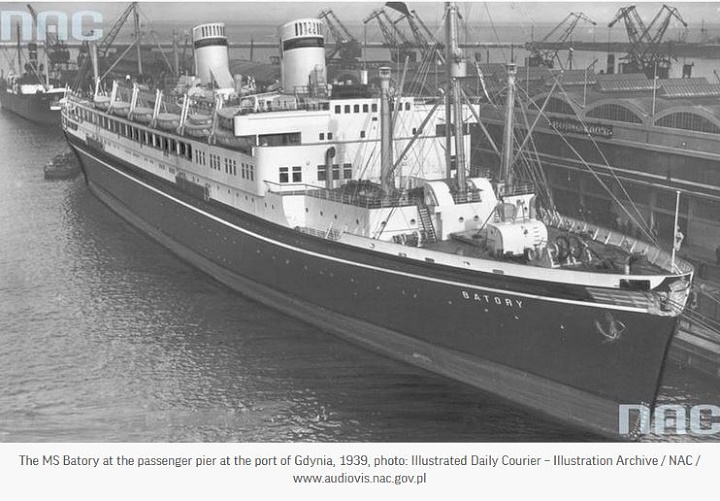
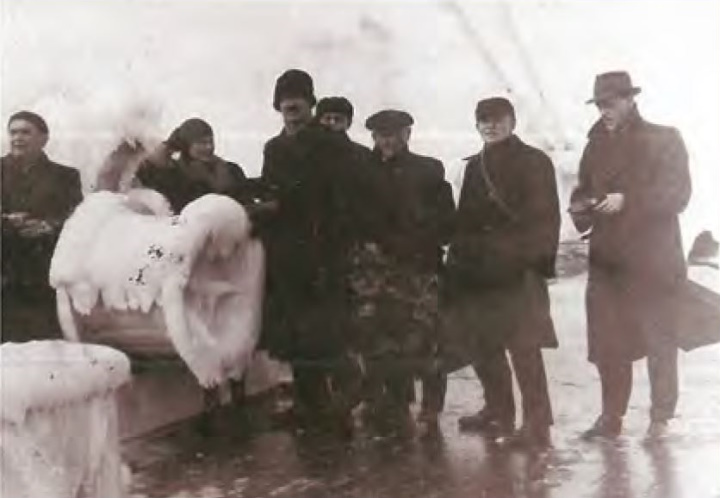 1939 – On February 28th, Boleslaw and Marja leave Poland on the Batory and arrive at New York on March 11th. In the group photo, Marja Cybis is the second woman from the left. In addition to the murals, a tapestry rug designed by the couple and titled Walking Through a Park, is also displayed. The Dayton Art Institute purchases two original circa-1920s Cybis paintings, The Bride and Peasant Heads.
After their work on the Pavilion is completed, Boleslaw and Marja embark on a tour of the United States, particularly the West and Southwest. The original Folio One drawings of Native Americans are created at this time.
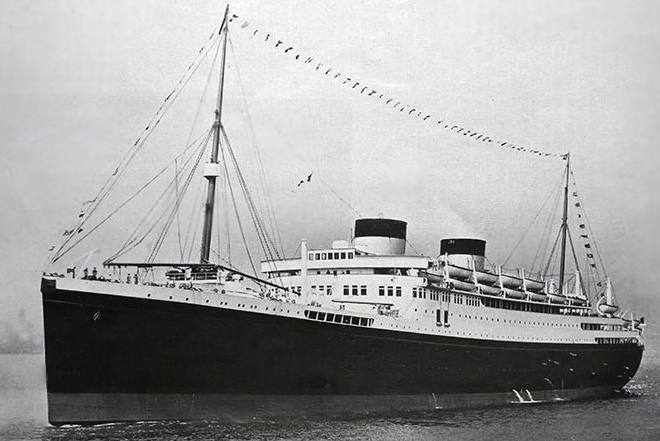
The couple returns to New York too late to make their scheduled sailing back to Poland, and must book passage on a later ship. They reach Sweden in mid-September just as the Germans invade Poland; they return to the USA on the SS Georgic sailing from England, and arrive back in New York on October 23rd.

 1940 – The couple establishes ‘Cybis Art Productions’ in rented living/working space within the Steinway Mansion on 41st Street in the Astoria (Queens County) suburb of New York City. The lower photo shows Marja with a selection of ‘lady busts’ there ; more are shown in this post. They take on several young apprentices from a local art school, including a talented Polish-born 18-year-old girl named Marylin Kozuch.
Also during this year, Boleslaw partners with several other ex-pats to open a Polish restaurant at 151 East 57th Street in New York City. The full story of the restaurant is related in this post.
1941 – In March, Boleslaw applies for a Social Security card; the Social Security number assigned to him is 055-18-7239. He makes preparatory sketches of maestro Ignace Paderewski in preparation for a portrait that was never completed due to Paderewski’s death in June. Later in the year, he wins the top prize for his Christmas-season window decoration fresco sculptures at a major department store on Fifth Avenue. Unfortunately, at about this same time, the Polish restaurant venture closes.
 1942 – On July 1st, Boleslaw files a declaration of intention to become an American citizen, giving his place of residence as 1833 41st Street, Astoria (the Steinway address). His vital statistics are listed as brown hair, brown eyes, height 5’6”, weight 178 lbs. Interestingly, this document says that both he and Marja last entered the USA from abroad less than four months ago (from Canada) and that their most recent foreign residence was in Montreal. The application states that they traveled from Montreal to Rouses Point, NY, by car. That village is just south of the border between Quebec and New York State, and there is a US Customs/Border facility there on Route 11.
1942 – The couple moves to Trenton in December and, with financial partners Wilson and Greenberg, rents a vacant ceramics studio (at either 314 or 316) Church Street from Clarence Alderfer. This becomes one of two locations for the production Cordey retail porcelain items (the other being the Arton plant in Philadelphia) as well as various experimental and avant-garde works including papka. (See the History of Cordey post for more details and location photos.)
The couple begin to construct a home and studio on Greenhouse Drive in nearby Princeton; the story of that property is in its own Archive post. Marylin Kozuch is among the employees who make the move from New York to New Jersey.
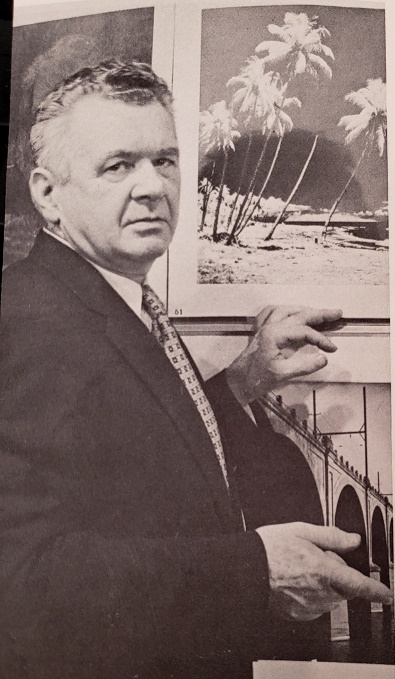 This undated photograph appeared in a 1964 Cybis studio brochure. Based on Boleslaw’s apparent age here, I’m going to guess that it was taken sometime in the early to mid 1940s, when he would have been between 48 and 50 years old.
1944 – The construction of the Cybis house and studio in Princeton is completed.
1945 – Boleslaw exhibits at Detroit Art Institute in June-July. An article in Art Digest, discussing the Polish art trends, comments that: “B. Cybis turns toward Polish peasantry and delights in the intricate details of the costumes, in contrast to the plain homeliness of the features which he renders with truly noble massiveness.”
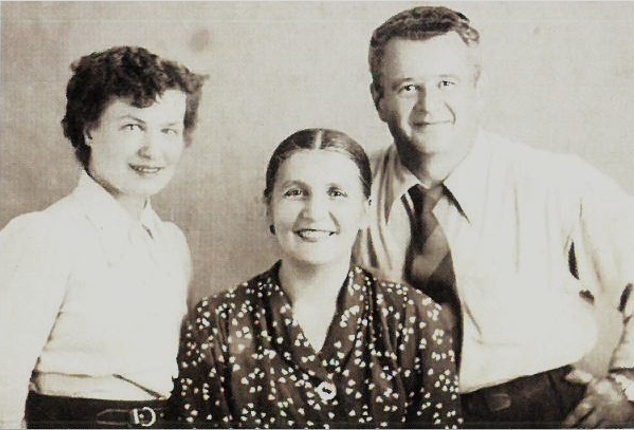 In 1945 or 1946 Nonna Łyżwańska (center), a childhood friend of Maria Cybis and now a nurse, spends six weeks in New York as part of an international nursing convention.
In November, a group of purchasers listed as ‘Jack Winston, Jack Wilson, Marie Cybis, Theresa Wicker’, under the corporate name of The Touraine Company, buys a building at 100 Enterprise Avenue in Trenton. Touraine was the original name of the Philadelphia-based lamp company owned by Wilson and Greenberg; it eventually became Arton Lamps, and then Cordey. The Enterprise Avenue location was purchased for Cordey manufacturing (in NJ) only; Cybis products were never made at the Enterprise Avenue factory.
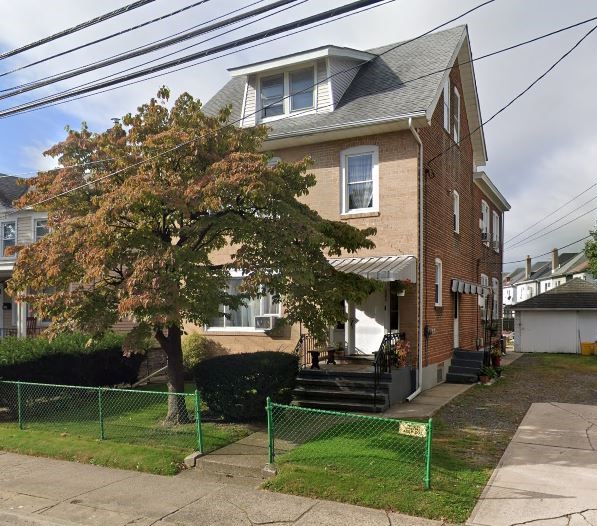 1947 – On April 29th, Marja Cybis buys a house at 851 Spruce Street, Trenton, from a seller listed as Art Modeling Studio, according to the grant of deed. It is possible that this was a paper transfer and that ‘Art Modeling Studio’ is actually either Boleslaw or Marja in legal disguise. The structure is a 2450-sq.-foot house, built in 1920 in a residential neighborhood with a large Polish population. It was purchased as a place for Marja’s brother Casimir and his wife to live after their planned emigration to America.
1948 – Marja Cybis becomes an American citizen on May 28th. Papers identify her as “Maria Cybis”. The witnesses, Theophilia Wolinski and Margaret Palonsky, say that they have known Maria since December 31, 1942, which is obviously when the Cybises first moved to Trenton. The paperwork describes Maria as 5’4” tall, 115 lbs, with hazel eyes. According to a magazine article published in Ceramic Industry magazine, the Cordey plant on Enterprise Avenue now has 250 employees.
1949 – Boleslaw becomes an American citizen on Nov 25, 1949. During this late-1940s period is when the Cybis operation on Church Street adds a young Navy veteran, Joseph Chorlton, to their roster as a traveling salesman.
1950 – Boleslaw exhibits at the Dayton Art Institute. Marja’s brother and sister-in-law, Casimir and Maria Tym, come to America on the SS Media on Nov 19th, bringing one trunk and 10 pieces of hand baggage. They are 53 and 51 years old at this time, and move into the house at 851 Spruce Street.
1951 – On February 20, Boleslaw and Marja purchase the Church Street properties outright. The sellers are listed as Clarence and Kathryn Alderfer, and the buyer as Boleslaw Cybis. The properties conveyed are #314 and #316 Church Street. However, immediately upon the sale, another takes place: Boleslaw and Maria Cybis sell the same properties to ‘Mary Gritzner, a widow’ for $4000 and at the same time execute a mortgage for $4000 from Mrs. Gritzer. Thus, the new owner is Mary Gritzner and the Cybises are once again tenants. Bank records show that a company called D’Orsay China is set up this year.
1952 – Significant renovations take place all year inside the two Church Street studio locations, funded by the D’Orsay China bank account.
The December 21st issue of Princeton Town Topics reports that “Eight Princeton women were awarded nurse’s aide certificates.” The list of names includes ‘Mrs. Maria Cybis.’
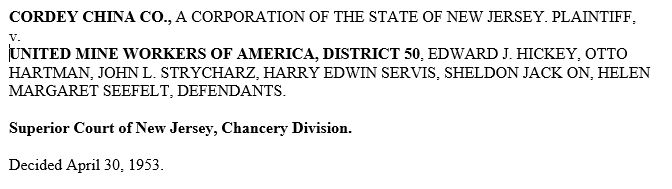 1953 – In February, representatives of the United Mine Workers union solicit the employees of the Cordey plant on Enterprise Avenue to organize. The management refuses the request, and on March 26th the Cordey workers go on strike. Two lawsuits resulted, and in the judge’s ruling of one suit is the comment that Boleslaw Cybis was unable to attend any of the negotiations “by reason of illness.”
The April 5th issue of Princeton Town Topics reports: “Fined $7 each for speeding were William H. Sayen, 4th, RD 2; Frank S. Wendt, 21 Morven Place; Miss [sic] Maria Cybis, Greenhouse Drive; Mrs. Mary G Nelson, Stockton Road; and 21 other drivers from outside the Princeton area.”
Renovations continue inside the Church Street buildings, funded via the D’Orsay China bank account.
The land upon which the Cybis home and studio were built is finally deeded to Maria Cybis on August 14th from its owner, Gladys Funk. See the Cybis home post for the background of this transaction.
In November, Cybis Porcelain is registered as a New Jersey corporation.
1954 – In May, the company(?) known as D’Orsay China apparently ceases to exist.
1955 – Princeton Town Topics’ rap sheet reports that “Those fined for speeding include” include seven names and addresses, the last being “Boleslaw Cybis, Greenhouse Drive.” It sounds as if both Boleslaw and Marja had a bit of a ‘lead foot’ on the gas pedal! The couples’ neighbor and friend, Albert Einstein, dies in April. A new Sanborn Fire Underwriters map of Trenton from this year shows that the property at 100 Enterprise Avenue is owned/operated by the Cordey China Company.
1956 – Marja’s brother Casimir Tym and sister-in-law Maria Helen Tym become American citizens on June 6th. (Casimir died on January 20, 1990 in Princeton. Casimir’s wife Maria lived to be 104 years old and died on Jan 27, 2004.) The Cordey China Company finally registers their trademark ‘signature’ for the first time this year, despite having used it since 1942. It is very possible that this action reflects a parting of the ways between Boleslaw Cybis and his partners.
1957 – On May 31, Boleslaw Cybis commits suicide, by an unknown method, at age 62. An article in Princeton Town Topics reports that he died at the local hospital “after a brief illness” and that “The funeral was held in Trenton, followed by cremation at Ewing Chapel.” Marylin Kozuch marries Joseph Chorlton and takes over the active directorship of the Cybis porcelain studio.
1958 – On June 14, Marja Cybis commits suicide at her home on Greenhouse Drive. The June 22nd issue of Princeton Town Topics reports (under title ‘Woman a Suicide’)”
DIES OF GUNSHOT. Mrs. Maria Cybis, 53, of 38 Greenhouse Drive, was found dead of gunshot wounds at her home on Saturday. Township police listed the case as a suicide, and reported that she had been despondent since the death of her husband, Boleslaw Cybis, last year. Both Mrs. Cybis and her husband were sculptors. A brother who lives in Lake Parsippany, NJ and a sister in Poland are her only survivors. The service at the Mather Funeral Home was followed by burial at the convenience of the family.”
The June 18th Princeton Herald includes a much shorter notice, stating that the funeral had been held in the morning and that she “died at her residence on Greenhouse Drive on Saturday. Mrs. Cybis, who was a sculptor, was a widow. She is survived by her brother Cazimir Cybis [sic; incorrect because his name was Cazimir Tym] of Lake Parsippany.”
Most of the contents of the Cybis house and studio are sold at auction in May:
 1959 – In January, Marja’s heirs Casimir and Maria Tym sell the Greenhouse Drive property. On May 19th and 20th, a local auctioneer sells off the remaining contents of the Cybis house from this location, billing it as containing “A lifetime collection of 2000 rare historical china and decorative items.” Not all the items sell initially, and a second liquidation sale (now described as a collection of 1000 items) is held on June 16th.
 On June 29th, the remains of Boleslaw and Marja Cybis are interred together at Princeton Cemetery.
It is not known when Casimir and Helen Tym moved from the house on Spruce Street to Lake Parsippany, but it must have been between 1950 and 1957. I could find no record of the disposition of the Spruce Street house. The death of Marja Cybis completes the legal transfer of ownership of the Cybis studio to Marylin and Joseph Chorlton.
The Cordey China Company files for bankruptcy, and holds a public sale of all its physical assets, in early April.
Epilogue
- In 1967, Marylin and Joe Chorlton (as Cybis, Inc.) purchase a third adjacent building on Church Street. This three-building location continues to produce only Cybis porcelain until the studio’s move to Norman Avenue in 1969.
- The Church Street properties are sold during the early to mid-1970s; the Chorltons acquire an additional two small properties on Norman Avenue, adjacent to the studio, as well as a home in Point Pleasant, New Jersey. The New Jersey State Museum mounts a major exhibit titled Cybis in Retrospect in 1970-1971. Marylin Chorlton dies of late-stage cancer in February 1977.
- In 1980 the studio acquires the original Cybis paintings Peasant Heads and The Bride at a Sotheby’s auction. Joseph Chorlton marries Theresa Rose during the mid-1980s. The Cybis studio experiences severe financial problems. In 1985, original pre-WWII paintings by Boleslaw Cybis (such as Toilette) feature in a major exhibit in Torun, Poland. In 1986, Jan Zamoyski, longtime close friend of Boleslaw Cybis, dies in Warsaw; in his posthumous memoir it is revealed that Cybis became “immersed in drug addiction” in spite of his financial success in America. The Cybis studio introduces a range of 50th-Anniversary designated pieces in 1989 and then closes down temporarily at the end of that year, laying off all of their employees.
- The Cybis studio officially reopens in 1990 and begins selling direct-to-consumer and also to the factory-outlet-tour trade; the Hall of Fame series of replicas of formerly-closed editions is launched; Casimir Tym dies. In 1998, the studio sets up a basic website, but without any actual online-purchase capability.
- In the autumn of 2002, the National Museum in Warsaw mounts a major retrospective of Boleslaw Cybis’ work; the catalog does not disclose his suicide but instead claims that he “died in Florida.” Helen Tym dies in 2004 at the age of 104. The final ‘original‘ Cybis Porcelain design (the Carousel Reindeer) is introduced in late 2008. The studio tries selling ‘imperfect’ and leftover pieces on eBay in 2009 but is suspended from the platform due to multiple buyer complaints.
- Joseph Chorlton dies in 2012. The Cybis studio building at the corner of Oakland and Norman Avenues is put up for sale in April 2019, while their remaining unsold back-stock is consigned to and sold by Kamelot Auctions in 2019 and 2020. The property is finally sold in 2021, after being on the market for almost two years, to an out-of-state corporate purchaser. Long since cleared of all remnants of its past as Cybis, the mostly-still-vacant property is currently for sale again (as of 2024) but at an asking price that is extremely unlikely to attract potential buyers.
Name Index of Cybis Sculptures
Visual Index (for human figures/busts only)
About the Cybis Reference Archive
What is Cybis?
Images of Cybis porcelain sculptures are provided for informational and educational purposes only. All photographs are copyrighted by their owner as indicated via watermark and are used here only as reference material. Please see the copyright notice in the footer and sidebar for important information regarding the text that appears within this website.
The Cybis Archive is a continually-updated website that provides the most comprehensive range of information about Cybis within a single source. It is not and never has been part of the Cybis Porcelain studio, which is no longer in business.
 THE CYBIS ARCHIVE