
Karat-gold paint has long been a traditional way to add ‘bling’ to porcelain figurines, although the extent to which different studios utilized it varied widely. For example, it is almost never found on Royal Worcester, Albany, or Connoisseur of Malvern pieces. On this side of the Atlantic, I’ve never seen a Burgues or Kazmar item with even the slightest trace of gold. Laszlo Ispanky wasn’t a particular fan of it either, except for his ‘Golden Touch’ series that featured an actual cast-gold element (not merely paint.)
Decorating Porcelain with Karat Gold
There are various ways to add gold decoration to ceramics, but here we’ll only look at real (karat) gold that is also fired onto the item. Often called ‘liquid gold’, it contains a lower percentage of actual gold than you probably suppose. A popular brand is Heraeus, made in Germany, which contains 10% of 24k gold; it is considered a Bright Gold and is intended for glazed objects only.
Another option is using a 22k gold luster. Unlike liquid gold, gold luster is red in the bottle and when applied. The real-gold content (typically around 7%) is suspended in a very volatile organic oil such as pine oil. When the painted item is fired at 1000°, the red oil burns off and what’s left is the remaining 22k gold. Because of high percentage of the VOC ingredient, gold luster is much more toxic to work with than liquid gold paint.
 Here are before-and-after photos of items decorated with gold luster (photos courtesy of Curry Wilkinson Pottery.)
There are many ‘gold metallic’ or ‘gold leaf’ paints that aren’t fired (so-called ‘no-bake’ gold paint) but those don’t contain any actual gold. Price is an indicator: If something costs between $60 and $100 for a mere two grams (less than 1/10 of an ounce), it should have real gold in it. If it costs any less, it certainly does not…even if it says “24k gold” on the packaging. That phrase only refers to the color, not the ingredients, which is why the word metallic also must appear somewhere on the packaging.
What Kind of Gold Did Cybis Use?
It’s interesting to look at how Cybis described their use of gold decoration in their advertising. The earliest instance I found is in a black-and-white1964 brochure with a House of Gold on the cover. Its description on the next page ends with “In lavish colors of Stained Glass Porcelain accented with 24 carat Old Coin Gold, $125.” Another panel shows the Holy Child of Prague, whose description reads in part “22 inches high in 24 carat old coin gold, adorned with jeweled colors…”. The line “24 Karat gold coin helps to create the brilliant brocade of the cape” appears on page 40 of the 1978 catalog A World of Enchantment, describing the same piece.
In the Fall 1980 brochure that included the Holy Child of Prague Plaque: “Using rare lusters and 24 karat gold, the artists of Cybis have achieved a stained glass effect..”
In the Spring 1985 brochure we find this: “King Arthur wears a tunic and robe elaborately embellished with 24 karat liquid gold…”. Liberty’s description contains two mentions: “Embellished with 24 karat liquid gold” and “a porcelain flag affixed to a 14 karat gold-plated staff.”
On page 85 of the 1978 catalog there is short glossary of nine terms, one of which is
“OLD COIN GOLD” – A unique high fired 24 Karat gold decoration to which Cypia tonations are applied to create an old world patina glazed Cybis sculpture. The process originated and developed by the Cybis Studio.
Cypia itself is defined directly above it, as “Bisque and glazed Cybis porcelains in “Sepia” tonations. Few produced.” (This Archive post looks at Cypia items in detail.)
The Cybis Studio’s Technique
A mid-1980s dealer marketing series of typewritten sheets called Technical Achievements goes into some detail in the one describing the 1984 Annual Egg.
To achieve the truly brilliant gold embellishing, glaze must first be applied to the designated area. This procedure is very time consuming. Some of the porcelain itself at times becomes mixed with the glaze resulting in dull spots after firing. This, of course, necessitates a second application and firing before going on to further decoration.
Applying the gold itself requires a steady hand since liquid gold applied to unglazed porcelain splays out immediately and cannot be removed. In areas where brilliant gold is desired, this necessitates applying liquid gold only to the previously glazed areas, no matter how small. In areas where the look of burnished gold is required, the finest brush possible is needed to apply the gold as judiciously as possible.
“Burnished gold” is what is separately cited (and IMHO much more accurately) as “matte” on the sheet for Madame Butterfly:
Applying the matte gold highlights is very demanding since the gold paint is absorbed by the unglazed porcelain immediately – allowing no room for error.
And for Othello:
Because gold applied to unglazed porcelain may not be removed, painting the elaborate design on Othello’s cape is especially demanding.
These excerpts give us an excellent idea of the technique involved in decorating a piece with gold. The main point is that the shiny/bright/brilliant gold is produced by applying the liquid to a previously-glazed area, whereas a matte/burnished/antique surface results if the underlying surface is unglazed. Visually, the color of both finishes does almost exactly match that of actual 24kt gold.
 The Cleopatra Bust is a great example of both application techniques. The blue lines point to areas of shiny gold (i.e., glazed underneath) and the pink lines point to the matte-finish areas. All of the areas between the ‘jewels’ on her collar and bodice ornament are matte gold even though only one pink line points to those.
1940s Gold-Decorated Cybis
All of the circa-1940s items that have any appreciable gold details were created in the Cordey overall style and are signed M.B. Cybis. Here are a few representative examples.
 This lady-bust lamp has gold not only decorating the base section (the typical Cordey look!) but also her scarf.
 This dancing couple is well-matched for bling!
 This colorway of the small pheasant is glazed white with gold accents, although only a few are catching the light in this photograph.
 This gold-decorated vase is almost 16” high.
 This teacup and saucer appear to have been decorated in the Old Coin Gold finish.
1950s Gold-Decorated Cybis
Most of the circa-1950s Cybis with gold decoration were the retail-market religious items, but there were at least a couple of them that were more esoteric.
 The main part of these two lady-handle tankards is decorated entirely in gold. They are so unusual that they have their own Archive post. One of them was purchased in 1956 at the studio, although it’s possible that they could have been actually created somewhat earlier.
The religious pieces sometimes received noticeable gold decoration, and the extent of it varied not only between designs but between examples of a single design. The most dramatic examples are those on which all of the subject’s exposed skin is painted gold.
 Gold-skin examples of The Annunciation and House of Gold, both designed by Harry Burger.
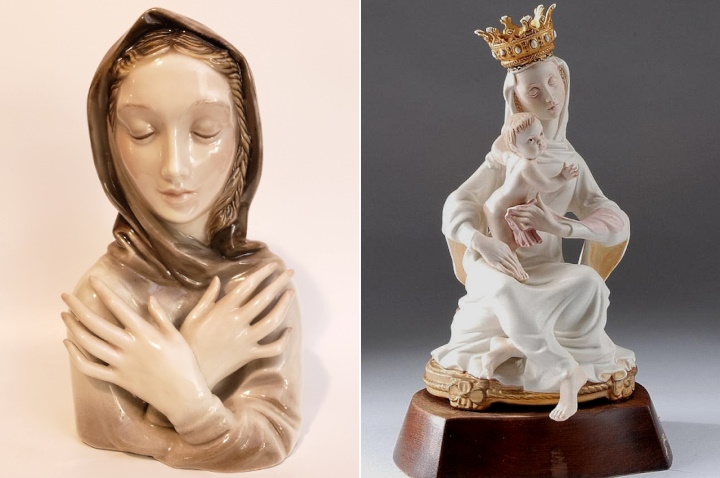 For comparison, here are their non-bling’d counterparts. This Annunciation has the Cypia finish. This House of Gold is the bisque version; the gold-skin one was made earlier and has the stained-glass finish.
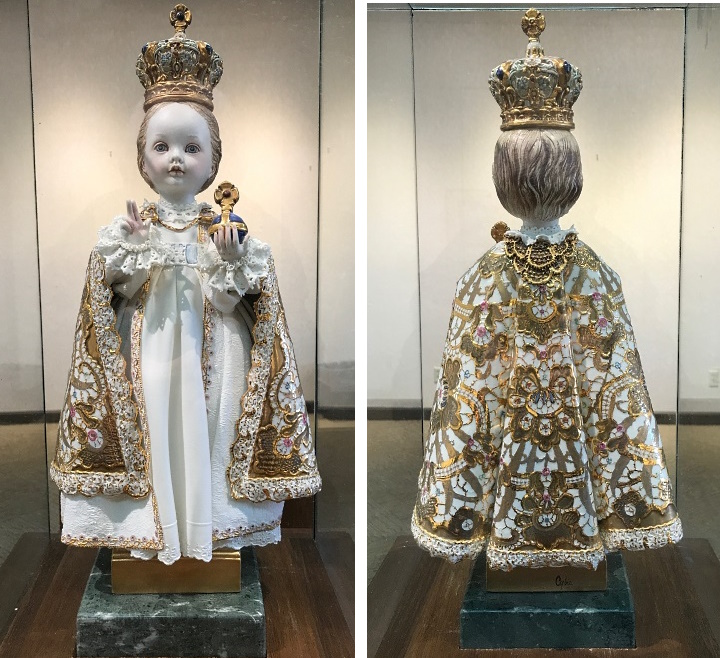 The piece-de-resistance of gold decoration during this decade was the Holy Child of Prague, introduced in 1956; he has his own Archive post.
1960s and 1970s Gold-Decorated Cybis
The gold-skin variants disappeared at some point during the 1950s and were only once seen again, decades later. During the 1960s and 1970s, while Marylin Chorlton was in charge of the studio, gold was limited to tasteful accents.
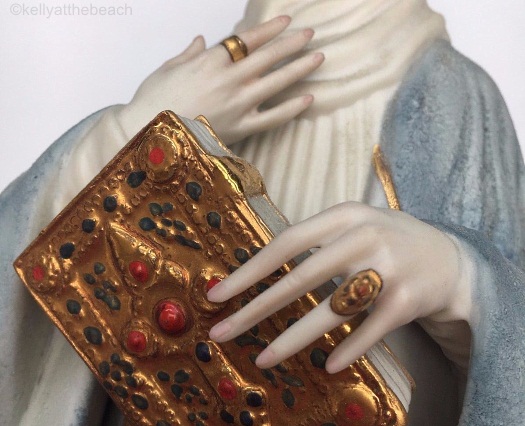 The book held by the 1971 Eleanor of Aquitaine is appropriately ‘gilded’ and ‘jeweled’ via paints
 Here is a comparison of how gold was used on the original 1975 Lady Macbeth and on the second Hall of Fame Lady Macbeth III in 1993. The original sculpture contains both of the gold finishes in multiple areas; the replica only gilds two elements and only as bright gold. Far more work was involved in creating the 1970s piece, and not only because that one was larger overall.
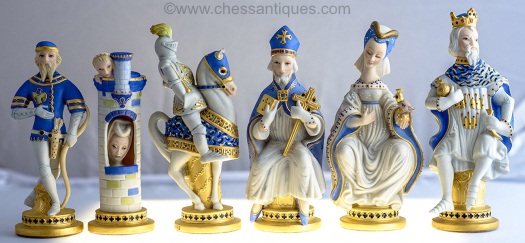 All of the gold on the 1979 Commemorative Chess Set pieces is matte, judging by the photographs available.
1980s Gold-Decorated Cybis
Almost all of the 1980s continued the trend of using gold only as an accent color.
 The 1980 Holy Child of Prague plaque has – as one would expect – plenty of gold detail on it. From the photos, it appears that only bright gold was used. This was a George Ivers project.
 Quite a bit of gold trim was used on Nefertiti but, given the subject, it’s appropriate. I do wish that they had used a different color for the foot-cushion, though! It is also historically inaccurate because the process to make Tyrian purple had not yet been discovered in Nefertiti’s time. Cleopatra really loved it, though!
 Accessories such as Richard the Lionheart’s goblet, crown and scabbard, and the aforementioned Othello’s cape details as well as his accoutrements, also made sense to decorate in gold.
However, the liquid gold really flowed for the 1989 introductions connected to the studio’s Golden Anniversary, as one might expect. The challenge there is one of where to begin!
The 1989 Golden-Anniversary Items
There is a separate Archive post with an overview of all of the Golden/50th Anniversary items but I would like to spotlight a few in particular.
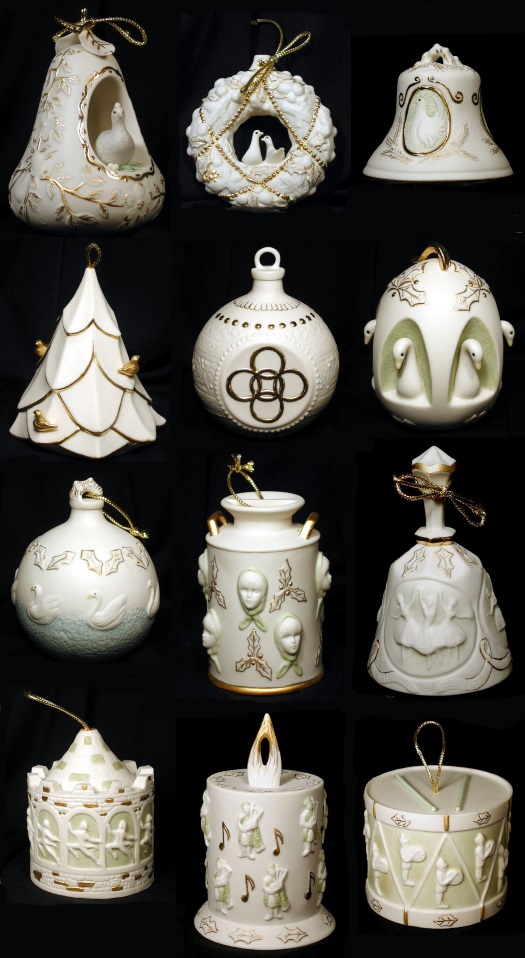 The Twelve Days of Christmas ornaments series was launched in 1989, with one new ornament introduced each year until 2000. As one would expect, gold is an integral part of this holiday series.
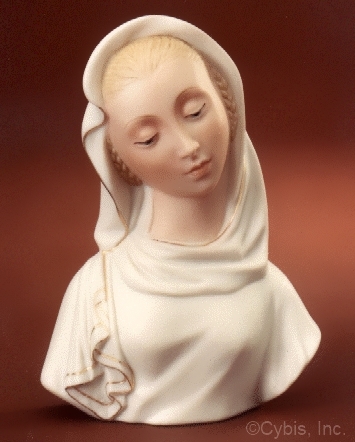 The 1989 Madonna Embellished with Gold is the retired 1960s ‘tilt-head madonna bust’ resurrected and given some very neat gold edging on her veil (which originally was blue and had no gold.) If you think she looks familiar, you’re not wrong: Look again at the House of Gold madonna!
 Rather more gold was applied to the 50th Anniversary Commemorative Egg which is the 1985 Annual Egg mold resurrected and bling’d.
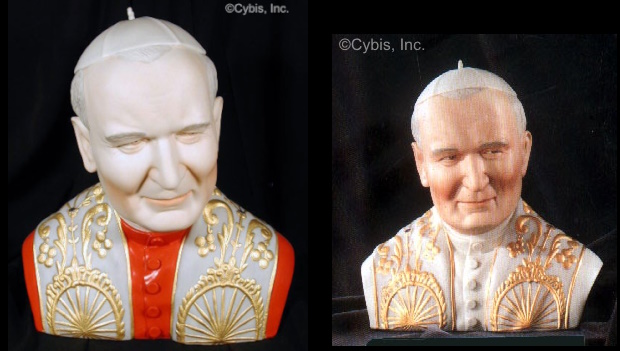 Two color options of The Pope included gold trim on the vestments: the 1989 color version and the downsized 1990 white-with-gold.
 The 1989 Holy Child of Prague II replica edition compared to its predecessor. The overall workmanship of the application on the later piece isn’t in the same league but that is not surprising because by that time almost all of the veteran decorators had either retired or quit.
The most extensive use of gold, in terms of number of pieces offered with that decoration, was the new colorway option added in 1989 to the existing ‘The First Christmas’ Nativity Series. For this new colorway, all existing color was removed except for the skin of the human subjects; any existing gold accents remained, and additional ones were added. The introductory flyer described these as “lavishly decorated in 24 karat gold” which is a phrase often repeated in other Cybis descriptions of 1989 items as well.
 The Shepherd is an excellent example. Here we see the original (color) version and the new ‘embellished with gold’ option.
You might assume that the gold-decorated version was more expensive, but the reverse was true; despite the more-expensive gold paint, the gold versions were priced $50 lower than the color versions because there was less labor (and one fewer firing) involved. At that time, Cybis was still offering the plain white bisque version although they discontinued it shortly after; using the Shepherd as our example, in 1989 he was $375 for white bisque, $425 for gold-embellished, and $475 for color. In either 1996 or 1997 the studio eliminated the pricing difference and charged the same amount for color or for white/gold ($675 in the case of the Shepherd.)
 I promised to explain the modern-day gold-skin item, and here it is. Here is the standard retail ‘with gold trim’ Christ Child with Lamb within the 1980s nativity series. The gold-skin example is one of an unknown number that were sent to retailers (it’s not known how many stores or which ones) as a promotional item. At least one of the retailers did offer theirs for sale because a correspondent has promised to send me a photo of hers; the one shown above was in one of the studio-liquidation auction lots in 2019/2020. This is the only known instance of the Cybis studio having produced a human figure with gold skin after the 1950s.
1990s Gold-Decorated Cybis

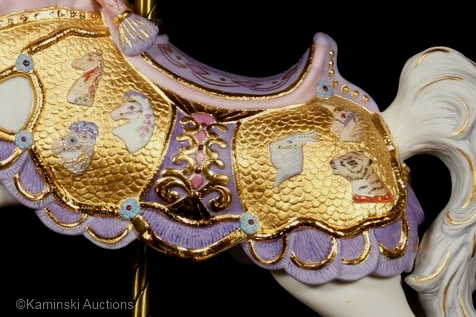 Carousel Horse ‘Golden Thunder’ is a 1990 introduction which was also marketed as an Anniversary piece. The sculpture was designed during the 1980s by Susan Eaton.
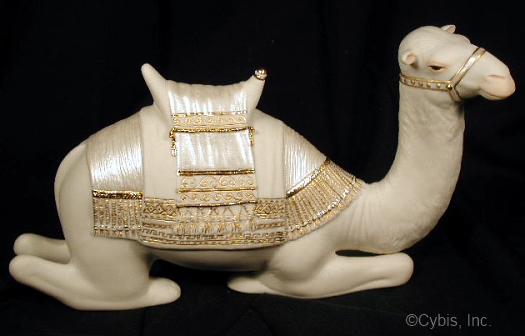 All of the items that were added to the Nativity Series during the 1990s were also available in the white/gold colorway. Almost all of them were ‘resurrections’ or combinations of previous pieces: The 1996 Nativity Camel III is simply the body of the 1982 Camel I with new leg molds stuck onto it so that he is ‘kneeling’.
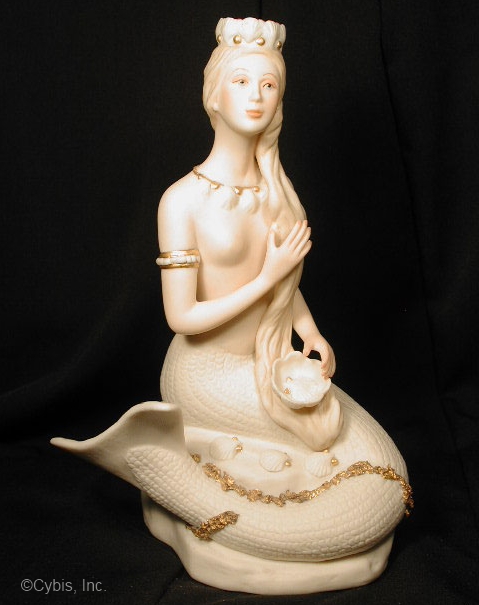 This new Mermaid appeared in either 1994 or 1995; this photo, originally on the Cybis Studio’s website, is the only one that I have ever found of this design. There was supposedly a color version, which I’m curious about because it might be quite pretty; if any reader owns one, I’d love to see a photo. She is also one of only four (known) Cybis females who were ever portrayed topless!
 More gold decoration appeared in 1997 with the introduction of the Collector’s Society pieces. As explained in their own post, the only original design was the Golden Princess which was Cybis’ extremely-obvious version of Disney’s classic Snow White. The 1998 Golden Prince is a resurrected and repainted version of Lynn Klockner Brown’s 1987 Prince; an uncrowned gold-embellished version was also sold at the studio itself as a ‘Golden Treasures’ item during this decade. All versions can be seen in the Princes and Paupers post. The Little Princess is the Flower Girl from the previous decade’s wedding party. Three small freebie pieces for members (a crown, a Comanche Chief medallion, and a mini Cybis sign) were painted in this same manner.
The Goldilocks Question: Not Enough, Too Much, or Just Right?
In my opinion, the Cybis studio’s use of gold decoration was – in most instances – just about right. The sculptures that do have extensive gold decoration, such as the Child of Prague versions and Golden Thunder, also have a good reason for it to be there. As for the 1950s ‘old coin gold’ finish or the gold-skin pieces, the like/dislike question comes down to individual taste.
An excellent illustration of the Cybis studio’s judicious use of gold decoration is to take a brief look at what their rival, the Boehm studio, did with the same paint.
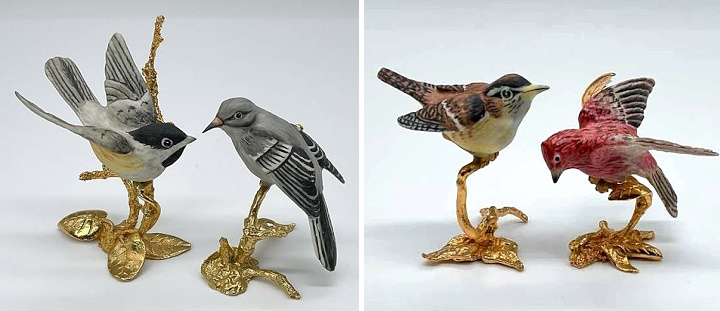 From a series of miniature birds on gilded bronze branches which were made separately in Boehm’s UK metal foundry (Boehm of Llandow) and shipped to the Trenton studio for the attachment of the porcelain birds.
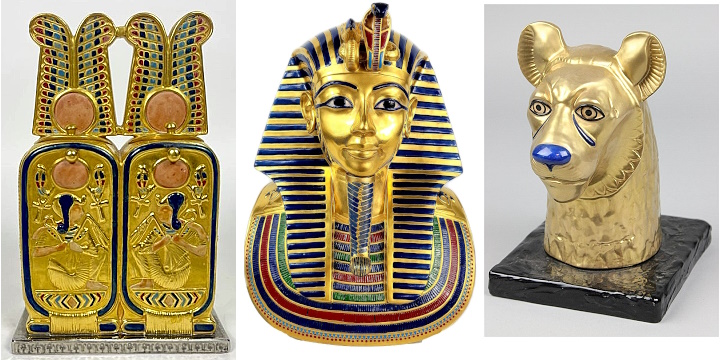 From the Treasures of Tutankhamon series at the end of the 1970s.
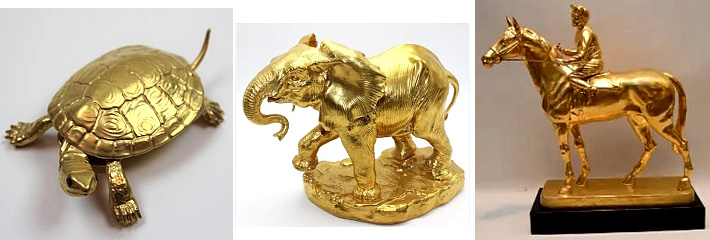 From the Gem and Gold series in the 1980s; tiny diamonds, rubies, sapphires or emeralds were used as the eyes. Despite the mega-bling, this series was very easy for Boehm to produce: bisque firing, glaze application/firing, gold painted over the entire piece (did they use an airbrush, I wonder?)/gold firing, and then finally glue the tiny gems into the eye sockets. There is no comparison here to the skill that was required to produce any of the gold-decorated Cybis pieces!
Name Index of Cybis Sculptures
Visual Index (for human figures/busts only)
About the Cybis Reference Archive
What is Cybis?
Images of Cybis porcelains are provided for informational and educational purposes only. All photographs are copyrighted by their owner as indicated via watermark and are used here only as reference material. Please see the Copyright Notice in the footer and sidebar for important information regarding the text that appears within this website.
The Cybis Archive is a continually-updated website that provides the most comprehensive range of information about Cybis within a single source. It is not and never has been part of the Cybis Porcelain studio, which is no longer in business.
 THE CYBIS ARCHIVE