
I thought it fitting to devote my final Artist Profile to an artist who was a mainstay of the Cybis production process: Ginny MacCotter, who deserves credit for so much more than collectors ever knew. She was also one of the longest-serving and most devoted employees of the studio.
She was born Anna Marie Magee in New Jersey on June 27, 1910, the first child of parents Bertram and Anna Magee. A younger sister, Dorothy, followed in 1912 and a brother, Frederick, in 1914. Her father Bertram was born in 1884, which means he was a decade older than Boleslaw Cybis. He married Anna Elizabeth Gulden in 1908 and during World War I he worked as a watchmaker for the Ingersoll Watch Company. The Ingersoll company was a trailblazer in the industry, not only for manufacturing the first truly affordable watch (it sold for only $1) in 1892, but also for the first radium-dial watch in 1919 and the first ‘character watch’ in 1933; it featured Mickey Mouse and was Disney’s very first merchandising partnership. In 1908 Ingersoll acquired the Trenton Watch Company, which was the location where newlywed Bertram Magee worked.
 Bertram’s 1918 draft registration card shows the Magee family living in this house at 4 Washington Street in Trenton.
In the 1930 Federal Census, Anna Marie is 19 years old and living with her parents at 509 Hamilton Avenue in Trenton. Because the Ingersoll Watch Company went out of business in 1921 as a result of the Great Depression, her father was now working as a watch repairman at a local jewelry store.
By now you are probably wondering how ‘Anna Marie’ became ‘Ginny’. And you’re not alone, because I spent quite a few years assuming that the Ginny MacCotter whom I’d heard so much about was actually named ‘Virginia MacCotter’ …a name that no search engine on the planet was able to find any match for. No census, no death record, nothing. It was only after discovering a (not-online) newspaper obit for Patricia Eakin two years ago that cited a comment by “her co-worker Annamarie MacCotter” that I finally had different name to search for. Et voila, there was Anna Marie MacCotter in the 1930 Census (most of the 1920 Census records were destroyed in a fire.) From there, it was easy to trace her back to 1910. But I still had no idea where the ‘Ginny’ came from. Was Virginia a second middle name?
Nope. When I had the good fortune to connect with Ginny’s grandson last year, one of the first things I asked him was ‘Why did everyone call her Ginny?’ The answer is one that I never expected: She had red hair, and it is very common in Ireland, England and Scotland to refer to a redhead as a “ginger”. “Ginger” became ‘Ginny’ at a very young age, which is what everyone called her afterward. Having only seen photos of Ginny with grey or white hair, I never thought of it as being any other color! A longtime mystery had been solved.
 In 1932, Ginny married Hugh MacCotter; their son, Hugh Bertram MacCotter, was born in June 1933 in Trenton. He was their only child. By 1940 the family was living at 12 McKinley Avenue along with Ginny’s married sister Dorothy, her husband, and their two children.
The first mention that I found of Ginny MacCotter in connection with Cybis is in the July 1953 D’Orsay China records; however, given that several people who knew Ginny have told me that she originally worked for Cordey, I will assume – given the lack of any surviving Cordey employee records – that she started at Cordey sometime after 1942. She may even have been among the six employees that this 1948 trade magazine article cites as being the original Church Street workforce. If so, she may have moved to the 100 Enterprise Avenue factory when it opened in 1946. Ginny’s father, Bertram Magee, passed away in 1948.
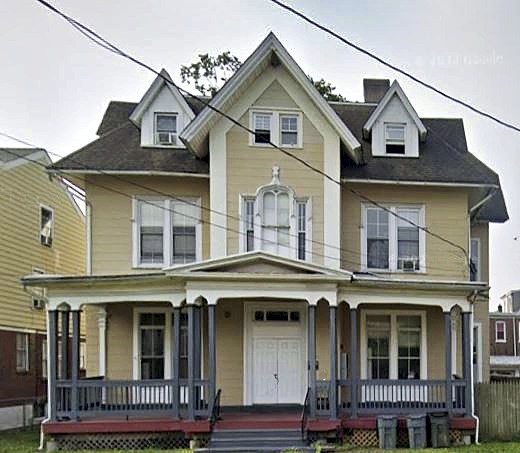 The 1950 Census, which is the most recent one publicly available, shows Ginny’s marital status as Divorced, and her occupation as a “sample maker at china company” working a 48-hour week. She and her son live in Apartment #6 at 455 Hamilton Avenue, shown above. It’s unclear whether the china company cited in the census is Cordey or D’Orsay. However, the fact that her name suddenly appears in the bank records of the D’Orsay China Company at 314 Church Street in June 1953 indicates that she probably shifted from Cordey-at-Enterprise to D’Orsay-at-Church Street at that time (which was shortly after the union-based lawsuit was filed against Cordey.) Ginny received several checks in June and July; the check that cleared on July 10th in the amount of $54.66 bears the penciled note 38 hours $62.70, $0.94, $7.10 above the net total. This means that she was being paid $1.65 per hour before taxes, which sounds grim nowadays but was in fact average or slightly above for a skilled factory worker at that time.
The Cybis porcelain studio was incorporated in New Jersey in November 1953, and luckily I have payroll records for the second half of the following year. It lists the employees at the Church Street studio; there were 18 at the end of the year. Only three other employees – Leon Koury, Vincent Grynceiwicz, and Gene Wojnarski – received an hourly wage larger than Ginny’s $1.73 …and even then, the highest was Leon’s at $2/hour. Leon was responsible for creating the liquid porcelain that all of the Cybis sculptures were cast from, so it makes sense that he was being paid top dollar. But Ginny was the highest-paid of all the female employees, which indicates that her talent as a decorator was particularly valued.
Ginny MacCotter at Cybis
Ginny MacCotter was not only a superbly accomplished artist but also one of the most beloved people at Cybis. Her enthusiasm and incredible sense of fun illuminated everything and everyone around her, and she was fiercely devoted to her family and friends. My photographs of Ginny all date from the 1980s (either press photos or candids) and so are from the Norman Avenue studio.
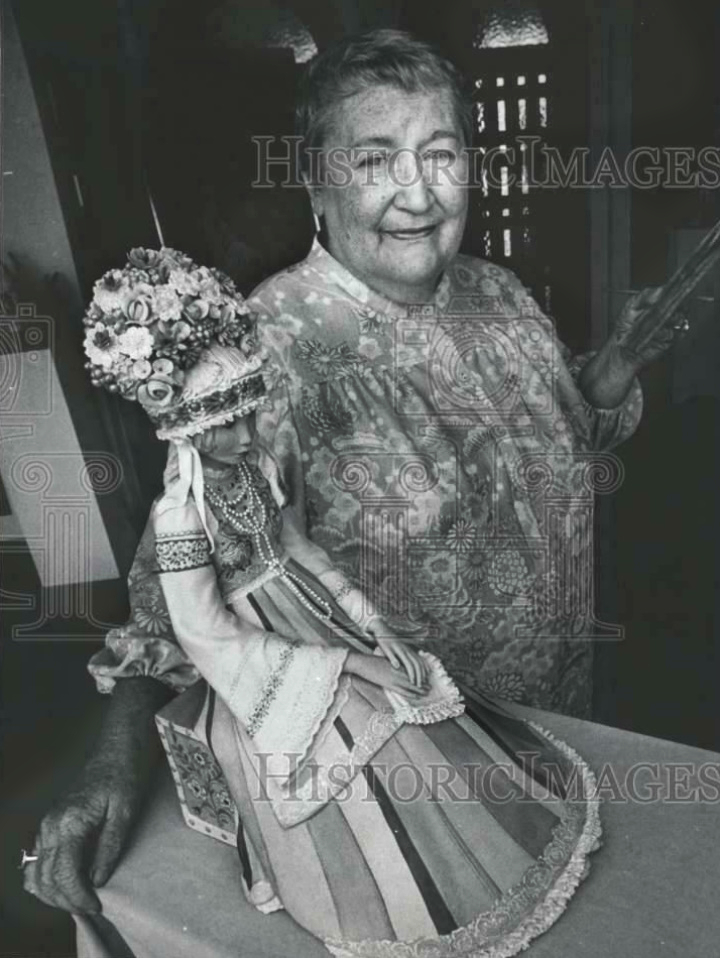
 These press photos of her with a ‘Polish Bride‘ were taken in 1980 when that sculpture was introduced. The color photo was published in a local newspaper on July 24th with the title “At 70, she’s become [a] classic Cybis herself” and the photo is credited to the paper’s staff photographer Bill Saunders. The text below the image reads
Ginny MacCotter helped create Cybis’ 40th Anniversary commemorative piece, “The Bride”, which depicts a Polish peasant girl on her wedding day. It is one of countless Cybis pieces she has worked on, none of which will ever bear her name. Now 70, she continues as a fulltime employee of Cybis.
Just barely discernable in the background of the color photo is the original Boleslaw Cybis painting The Bride, which inspired the sculpture. The studio purchased the painting at a Sotheby’s auction in April 1980.
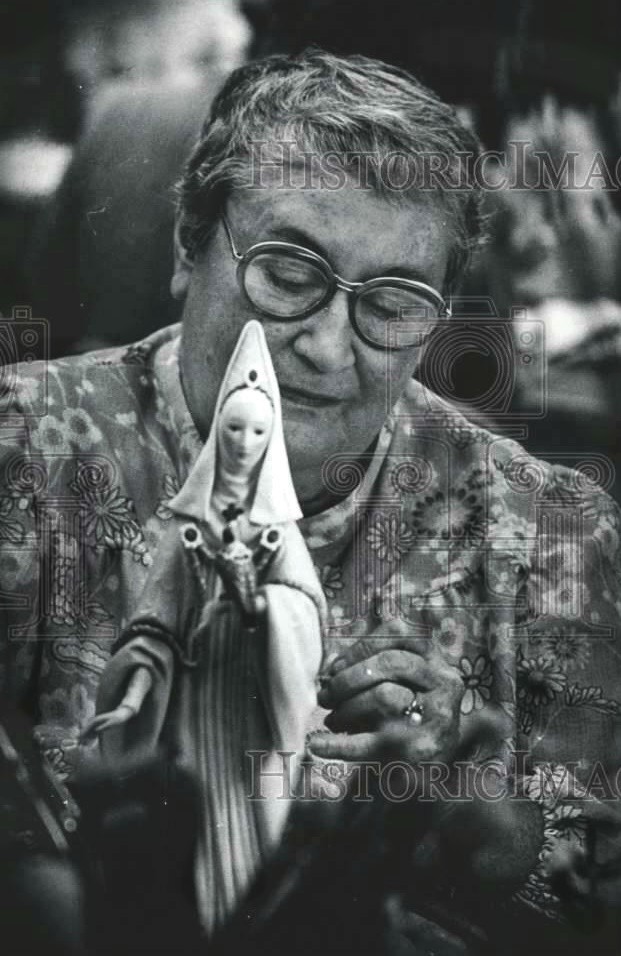
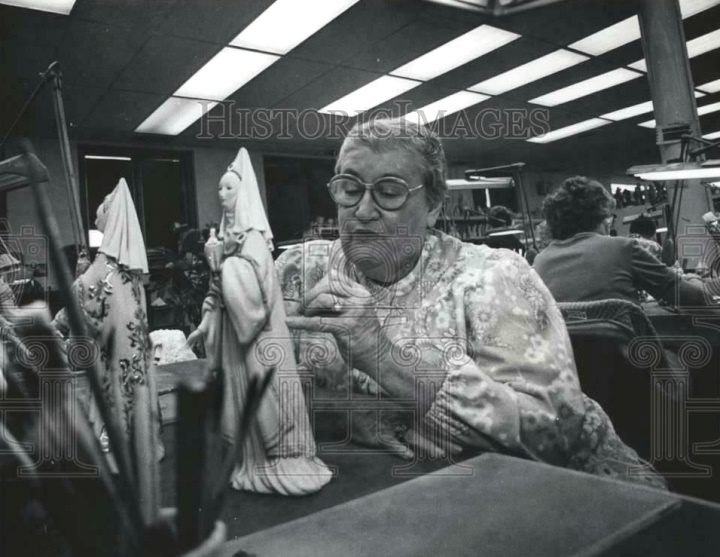 All of the above press photos of Ginny with a Berengaria were taken at the same time as the Polish Bride photos; Berengaria‘s edition of 500 was introduced in 1979 and completed in 1981.
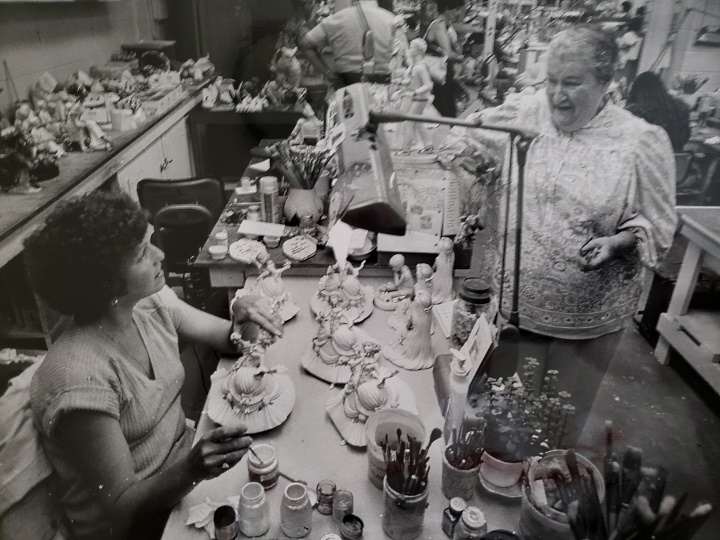 Another workroom photo shows Ginny conversing with one of the decorators, who has nine sculptures vying for her attention: five Cinderella at the Ball, three Rapunzel, and a Christopher. Among the many sculptures seen on the other worktables are a male Jogger and a Great Horned Owl.
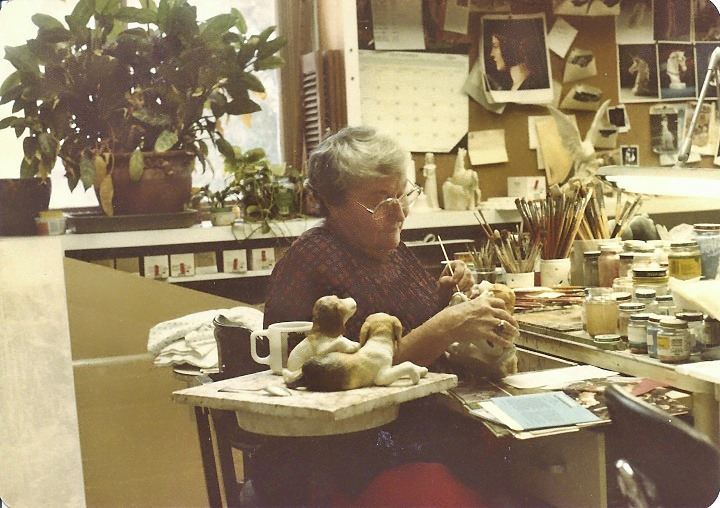 This candid snapshot of Ginny at her table, painting a Branigan and Clancy, was taken in September 1984.
 Life was not ‘all work and no play’ at Cybis, and Ginny always got into the spirit of things, as these candid shots show! Here, Ginny celebrates with Lynn Brown and Patricia Pae at a 1980 wedding reception.
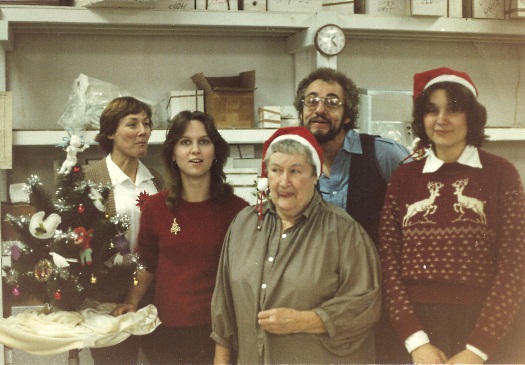
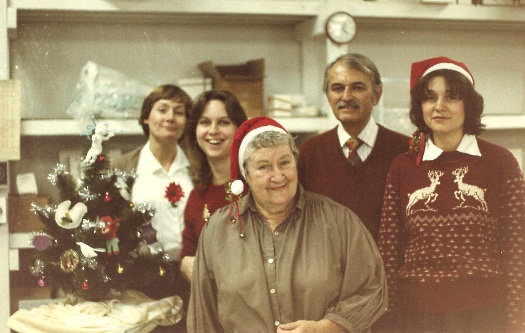

 Here, some holiday hijinks in 1982. That’s Bill Pae mugging it up behind Ginny in the first photo, and then replaced by George Ivers in the second. Joseph Chorlton sports the #1 sweatshirt in the third, and the jingle-bell-and-holly girls are Ginny and Patricia Pae.
Ginny MacCotter’s Non-Cybis Art
I wish that I knew more about Ginny’s non-Cybis art, because her talent was not limited to only the decoration of porcelain.
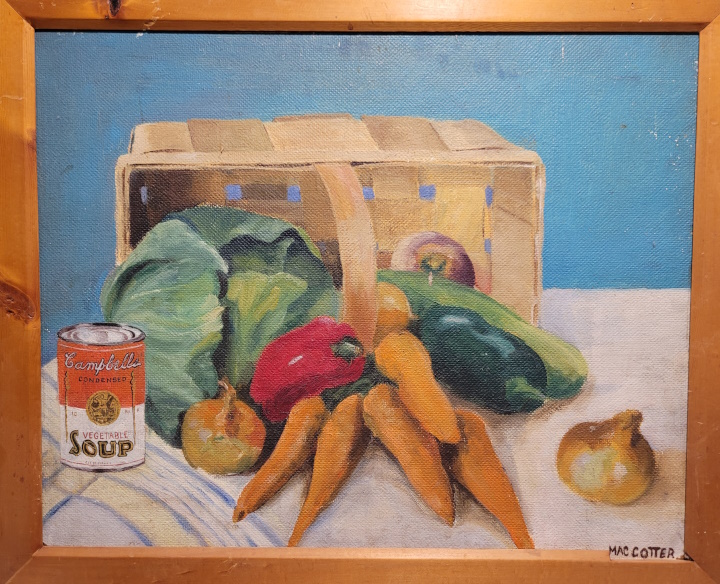
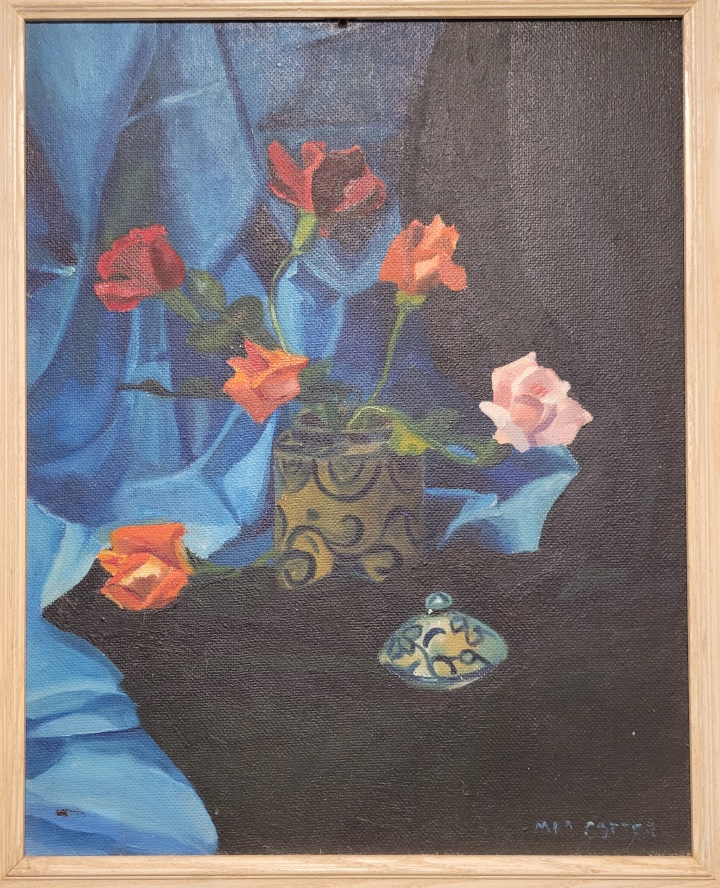 Her grandson Sean shared these photos of two of her many paintings that filled her home studio: Still Life with Veggies and Soup, and Red Roses and Blue Silk. The blue-on-white pattern on the vase is very reminiscent of the blue-curlicue design that is found on many of the 1940s Cordey figurines, and on several early Cybis ones as well.
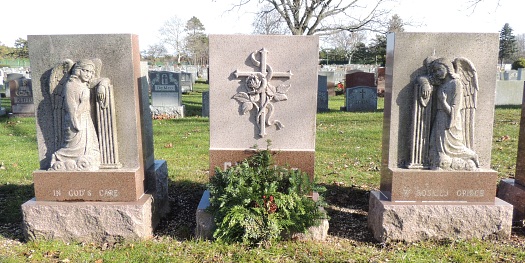 I was told by one of her colleagues that Ginny designed the three granite headstones for Marylin Chorlton’s gravesite on Long Island.
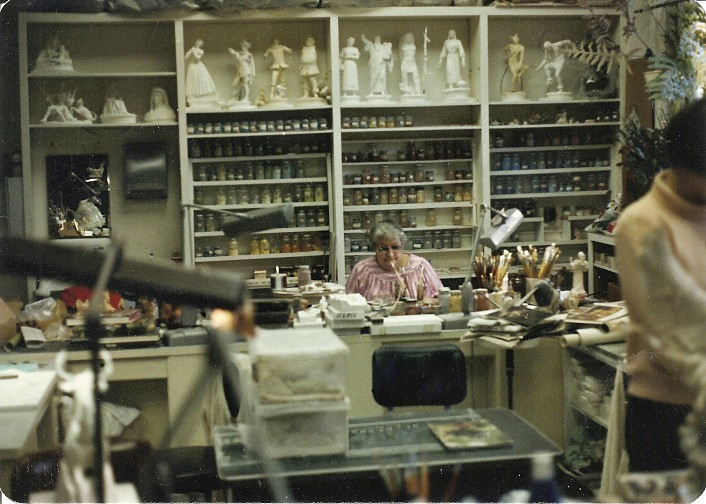 A candid photo of her at her Design Room station, taken in September 1985 when Ginny was 75. In 1986, a desperate attempt to right the studio’s floundering finances prompted the dismissal of a number of the artists; Ginny MacCotter was one of them. I cannot imagine being tasked with telling the person who had been working for Cybis longer than anyone other than Joseph Chorlton, to not return to work the following week. That said, at least it spared her the indignity of being at the ‘pink-slip party’ in 1989, at which every employee was unexpectedly dismissed a few days before Christmas.
Anna Marie “Ginny” MacCotter passed away on November 7th, 1995 at the age of 85. She was a cornerstone of the Cybis studio for more than 35 years.
Name Index of Cybis Sculptures
Visual Index (for human figures/busts only)
About the Cybis Reference Archive
What is Cybis?
Images of Cybis porcelains are provided for informational and educational purposes only. All photographs are copyrighted by their owner as indicated via watermark and are used here only as reference material. Please see the Copyright Notice in the footer and sidebar for important information regarding the text that appears within this website.
The Cybis Archive provides the most comprehensive range of information about Cybis ever compiled within a single source. It is not and never has been part of the Cybis Porcelain studio, which is no longer in business.
 THE CYBIS ARCHIVE