
Although there is an Archive post showing examples of the Cybis studio’s publications and advertising, I did not delve into the actual relationship that Cybis had with its retailers. It turned out to be quite an interesting case study.
The history of ‘modern’ (i.e., recognizable by most people) Cybis begins in the late 1950s, when Marylin and Joseph Chorlton fully inherited the studio after the deaths of Boleslaw and Marja Cybis in 1957 and 1958. At that time, they had an existing retailer base from the 1950s giftware lines which were primarily pieces cast from other companies’ molds. Sadly, internal documents from that era have been entirely lost except for one rumored sales notebook that once belonged to Joe Chorlton and which may or may not still be in the possession of his widow, Theresa. Whether that book contained the names of specific 1950s retailers is not known, but it would be a fascinating source of data if it did.
The best way to look at Cybis’ relationship with their retailers is in timeline form, with examples of advertising placed by both the studio and the stores.
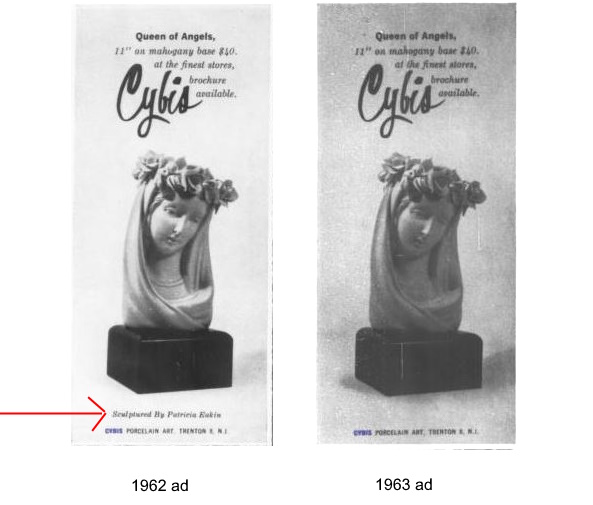 The earliest modern Cybis Studio ad that I have found comes from 1962 in The New Yorker. It shows their Madonna ‘Queen of Angels’ and – in an extremely rare example of credit – includes the name of its designer, Patricia Eakin. The exact same ad in the same magazine the following year, however, omits that line.
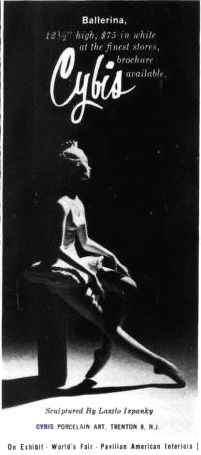 A 1965 ad in the same magazine for Ballerina ‘On Cue’ credits Laszlo Ispanky as the designer. Ironically, Ispanky and Cybis would part ways the following year – in part because the studio refused to give him public credit (his argument) and also because Ispanky was repeatedly exhibiting works sold under the Cybis name as solely his own (the studio’s argument.) After that messy divorce, Cybis never again credited a designer in print; and only two designers ever had their name appear on any Cybis retail editions: George Ivers (the various Limnettes) and J. Nelson Slick (Nashua.)
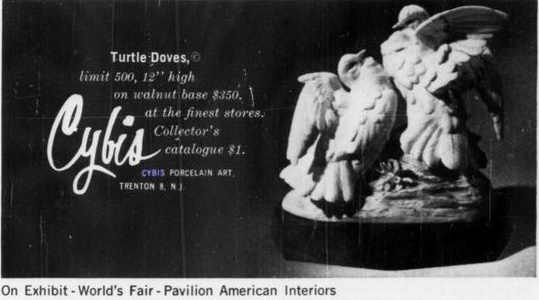
Because the studio was exhibiting at the 1964-65 World’s Fair in New York, this 1965 New Yorker ad for the Turtle Doves – as well as the one for On Cue – includes the tagline that Cybis pieces can be seen there in the Pavilion of American Interiors. I also found a 1964 Baby Owl ad which was too dark to be worth reproducing but has the same tagline.
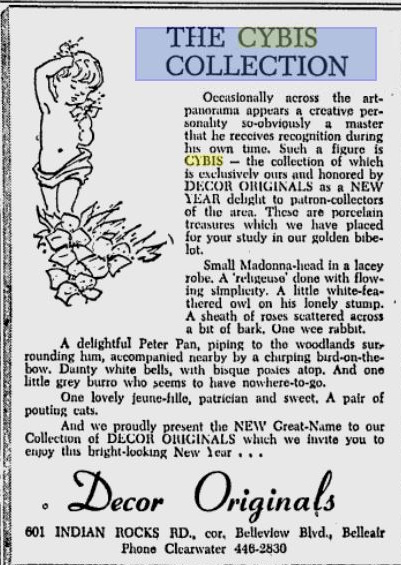 Here’s a January 1, 1964 retailer ad from a store in Florida. Some of the described pieces are easy to identify: The first Madonna with Lace, the Baby Owl, Mr. Snowball, Peter Pan, Burro ‘Fitzgerald’, and the 1950s Wedding Bell. However, the “religeuse” could be any of the madonnas; the roses-on-bark are a mystery; and the “jeune-fille” (‘young girl’) could be any of several. The “pair of pouting cats” really confounds me because the only feline they made during the 1960s was the sleek and composed Cat who is absolutely not “pouting” or ever sold as a pair! The accompanying sketch doesn’t match any known Cybis item.
During the 1960s, Joe Chorlton was busily ensuring that the studio brought itself to the attention of their most important target market which was People with Disposable Income. Collectors who shopped at Sears or at their neighborhood A&P supermarket might buy a $25 Baby Owl but they were unlikely to afford a Juliet at ten times that price, or to drop $1100 for a Great White Heron however much they might admire or covet it. So, some serious schmoozing of the ‘upper classes’ was necessary. A byline in a 1968 issue of Variety magazine describes an upcoming big-bucks charity event:
The establishment of an annual international award in the field of cancer research, sponsored by the Empress of Iran […] will be presented at the annual Peacock Ball. The May 4 event, to be held at the New York Plaza Hotel, is the 13th sponsored by the Lila Motley Cancer Foundation. Cybis Porcelain Corp., Trenton, N.J., is underwriting this year’s ball, which is chaired by Mrs. [Roz] Levine.
 The first Chorlton-era retailer ad that I came across is from 1971, placed by one of the studio’s larger-volume retailers: Armstrong’s Gallery in Pomona, California. Appearaing in The New Yorker, it introduces Eleanor of Aquitaine and heavily stresses the investment potential of Cybis porcelains.
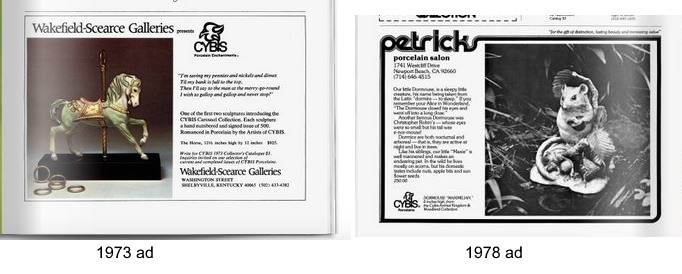 This 1973 ad by Wakefield-Scearce Gallery in Kentucky for the Carousel Horse uses the color stock photo supplied by the Cybis studio. Cybis would send reams of such ‘glossies’ to their retailers; some were in black and white, others in color. The 1978 black-and-white ad from another California retailer, Petricks, shows Dormouse ‘Maximilian’; it also uses the studio’s stock photo, although this retailer opted for the less-expensive black-and-white advertisement rather than color.
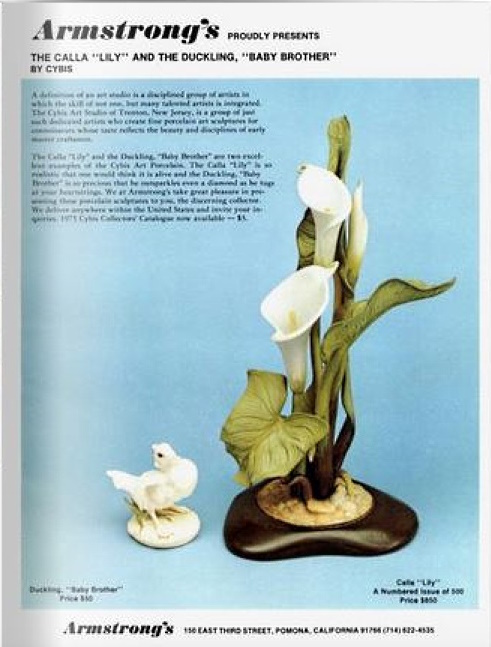 Retailers like Armstrong’s were perfectly willing, during the boom years of the 1970s, to spend money on full-page color magazine ads, as this 1973 one shows. Armstrong’s also printed their own Cybis price lists that included their own added graphics and introductory texts.
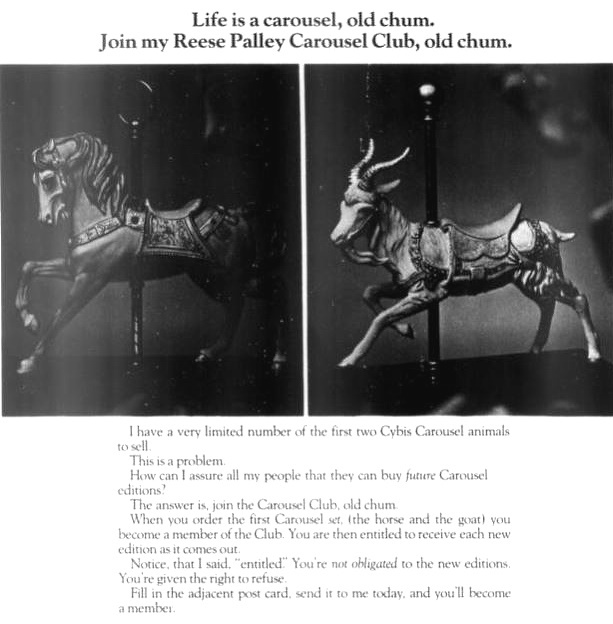 The Atlantic City gallery owned by Reese Palley jumped on the Cybis bandwagon during the 1970s after having been almost exclusively a Boehm retailer for some time. Reese was similar to Helen Boehm in that he had a nose for any possible marketing hook. This 1973 magazine ad (originally in color) tempts customers with an in-house ‘Carousel Club’ so that they would not need to worry about missing out on a sculpture as a result of high collector demand. (Nerd Note: Both of these stock photographs were printed in reverse in this ad! See the Carousel Horses and Carousel Animals posts for the actual Cybis photos. I wonder whether anyone at Reese Palley ever caught the error?)
Ira Jacobson of Brielle Galleries had his own way of solving the demand problem: He struck a deal with Cybis whereby Brielle placed regular full-page full-color ads in high-end magazines such as Architectural Digest (thus saving the studio the expense) and in return, Cybis allocated a larger-than-normal percentage of the production run of available sculptures to Brielle.
 This 1974 magazine ad from Armstrong’s contains a unique message that I have not seen in any other advertisement. The second paragraph reads
Armstrong’s also provides a service to help collectors locate CYBIS sculptures for their collections. We are currently looking for ‘Blue Bird by the Garden Wall’, ‘Branch with Apples’, ‘Male and Female Parakeets’, ‘Fawn’, ‘Hummingbird’, ‘Polar Bear’, (unreadable), ‘Holy Ghost’, and ‘Ca(illegible)’. If you know the whereabouts of any of these pieces, we would be very interested in obtaining them for several of our clients.
The maintenance of a want-list by a retailer was not new; what is unusual is seeing a national advertisement mentioning specific items. Someone must have REALLY wanted to find those pieces!
The 1970s also saw the introduction of special Cybis retailer events to which collectors were invited and where they could see the new Spring and Fall introductions. Specially-colored or decorated versions of a particular open-edition sculpture, usually made in a fairly small quantity, were available in connection with these events. These were never on the standard Cybis price lists, and so if you weren’t in the gallery’s customer database you had no idea they existed. Most of the retail event versions were even nicer (in my opinion) than the originals!
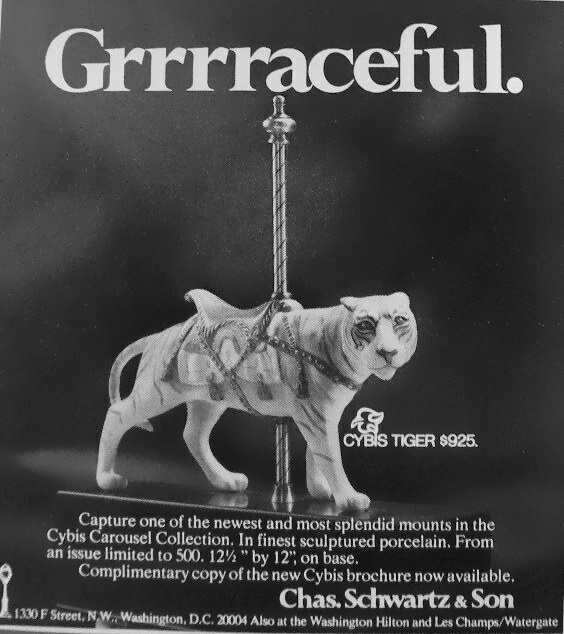 This 1974 ad for the Carousel Tiger was placed by Charles Schwartz & Son, the most prestigious jewelry store in Washington D.C. When the 1964 World’s Fair was over, the Cybis Flower Bouquet of the United States spent several years on display there, before Mr. Schwartz eventually donated it to The Smithsonian.
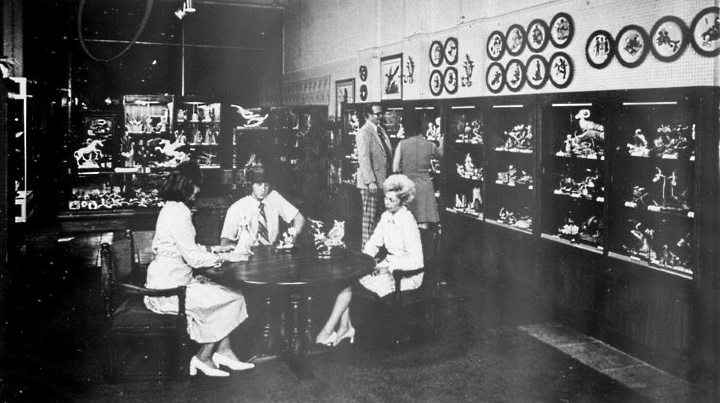 This photo was taken inside Armstrong’s in 1975. A Cybis Unicorn and Pegasus sit atop the glass display counter behind the table. The sculptures inside the first three (at least) display cases along the wall are from Boehm.
 Acquire magazine debuted during the 1970s and was laser-focused on the burgeoning collector market. It wasn’t uncommon to see Cybis ads from competing stores on facing pages, as this 1975 issue of Acquire shows. Douglas Lorie in Palm Beach touts Pansies ‘Crinoline Lady’ and Kitten ‘Tabitha’ while Brielle Galleries focuses on three items in the studio’s Caprice Collection. These ads were originally in color but the online database did not scan them that way.
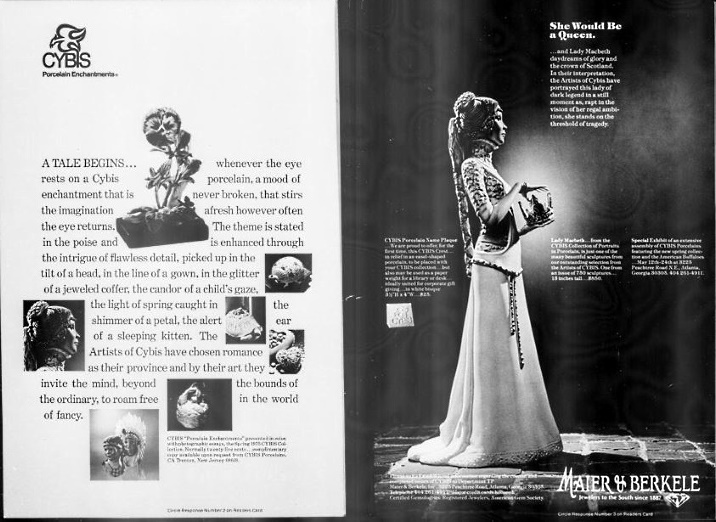 A later issue that year has an informational ad from the Cybis studio facing one from their Southern retailer Maier & Berkele. This photo of Lady Macbeth was done by the retailer, not by the Cybis studio. These ads, too, were originally in color.
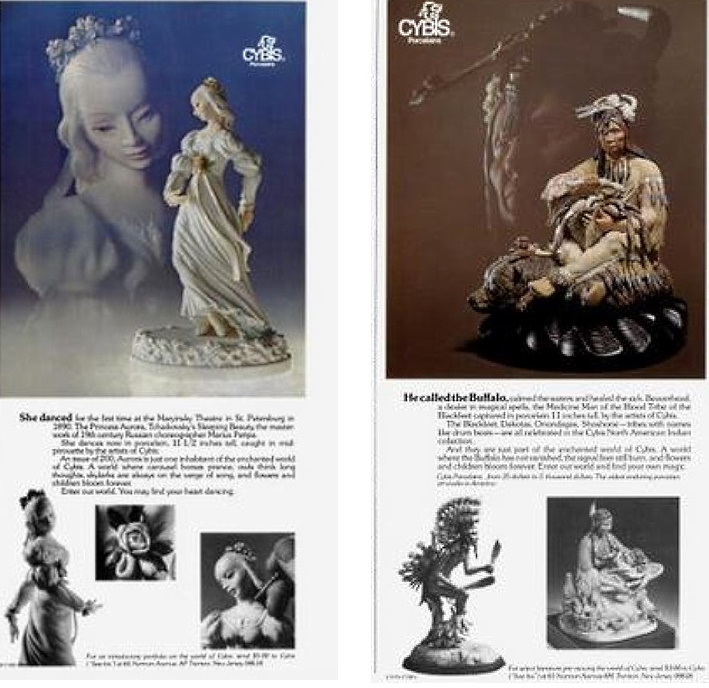 The Cybis studio itself continued to place ads in various publications. While the ad for The Enchanted Princess Aurora features only that one sculpture, the one for Beaverhead Medicine Man also includes the Crow Dancer and Sacajawea as black-and-white insets. Both of these ads ran in 1977.
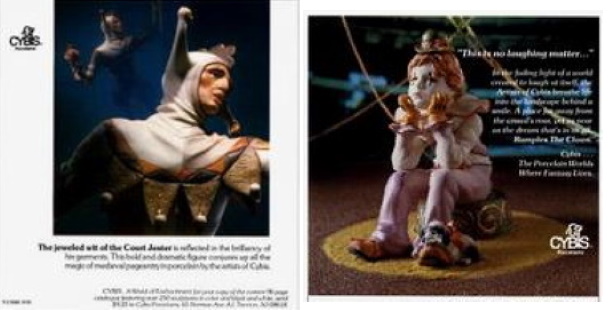 Cybis also placed smaller and less expensive quarter-page ads of their own, such as these in 1978 and 1979.
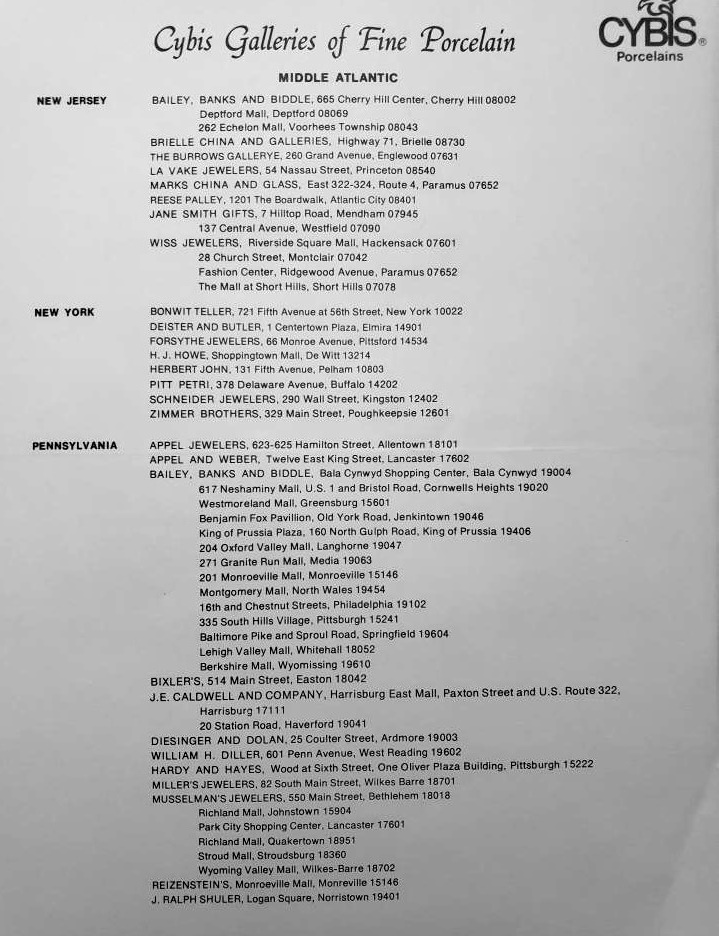 This is part of a 1978 list of retailers that was sent directly to collectors so that they would know where to see and purchase Cybis pieces. Although the internet and online ordering were still decades away, collectors could (at most galleries) create a want-list and place orders by mail or phone. Notice, too, that some retailers had multiple locations; it was easy to have a piece that might be in-stock at one of them, shipped to the store that was closest to the customer or even shipped directly to the customers themselves; after all, the profits all went into the same corporate pocket. Jewelry stores were a major retail partner category for Cybis; there are ten identified here as ‘jeweler’ in their name. On the other hand, some – such as Herbert John in Pelham, NY – were strictly gift shops; some of those were quite small and did not have the display space for more than the most recent sculptures. There were a few department stores too: Bonwit Teller, although listed here only in New York City, had a dozen branch stores in multiple states. In fact, their Long Island store was where I bought my first two pieces of Cybis; the store was right across the street from where I worked during the 1970s. The flagship store in New York City would have had a larger number of Cybis on display, but the branch stores had quite a few pieces and also a supply of Cybis brochures and price lists. Bonwit Teller also carried Boehm porcelains as well.
 By 1980, retailers were not shy about advertising higher-priced Cybis sculptures. This ad from Byerly’s includes the limited editions High Rise ($475), Eskimo Mother ($2500) and the Arctic Fox ($4500.) These were all Cybis stock photos.
 The studio liked to place ads showing a diversity of sculpture types to emphasize the ‘something for everyone’ mindset. This 1980 ad from them shows (from left to right) Pollyanna, Noah, Bunny ‘Mr. Snowball’, the Kestrel, Apache ‘Chato’, Eros, the Iris, Pink Parfait Rose, Pegasus, the Baby Owl, the Knight from the Chess Set (even though it was absolutely not available separately), Berengaria, and Betty Blue. Of the pieces shown in the ad, Mr. Snowball, the Kestrel, Chato, Eros, Pink Parfait, Berengaria, Betty Blue and the Baby Owl were still available to order at retailers in 1980. But Pollyanna had been retired five years previously, Noah‘s edition was closed in 1979, and the Iris had not been available to order for an entire decade (the edition had been completed in 1970.)
 In 1981, in-house marketing director and former ad executive Tony Trezza created a marketing campaign that literally brought the newest Cybis introductions to his beloved Italy. These are two of the several ads that resulted; see Cybis Goes to Italy for the story of the trip and a number of candid photographs.
Joe Chorlton made sure to keep Cybis pieces in the public eye of society. In addition to the various Gifts of State that were sent to Washington during the 1970s and early 1980s, he kept ties with local New Jersey political and social connections. At the 1981 Inaugural Party for governor-elect Thomas Kean at Drumthwacket (the governor’s mansion), a local paper reported that “The gifts for the guests were Cybis porcelain roses.”
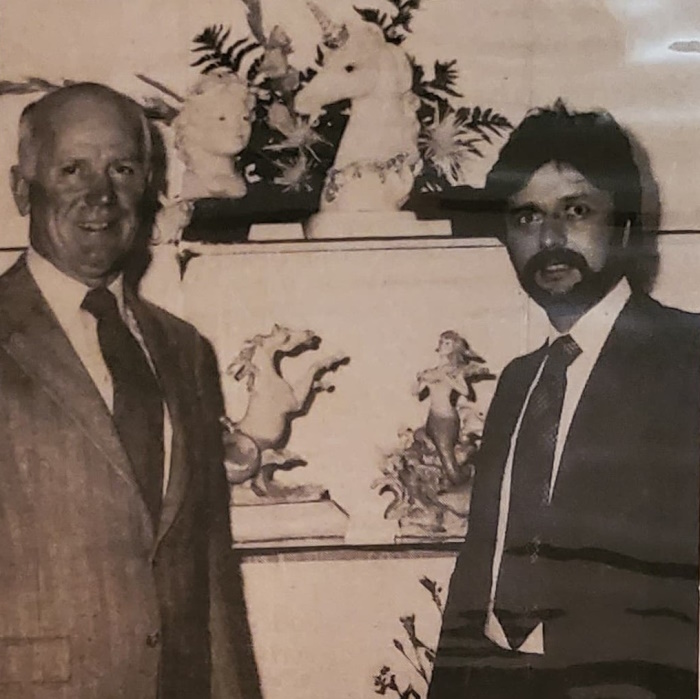 Although the first, and most comprehensive, public display of Cybis porcelain took place in 1971 (Cybis in Retrospect, at the New Jersey State Museum), the studio collaborated with Indiana-based jeweler Kruckemeyer & Cohn in May 1982 for a larger-than-typical retailer event. The men in this photo are Joe Chorlton and John Murphy who was the studio’s Communication Director, at the Evansville store event which was titled Cybis: Past, Present and Future. The actual oil paintings of The Bride and Peasant Heads, acquired by the studio at auction in 1980, were part of the show; the 1971 exhibit could only display photographic reproductions of them. A local paper, reporting on the event, said
Perhaps the most unexpected grouping in the show was the angel and folk sculptures done in ‘papka’, an unfired clay composition created during the studio’s earliest days. Because of their extreme delicacy, the sculptures had never been exhibited outside the studio, according to Chorlton.
This was not strictly accurate, because those pieces are documented as being part of the 1971 Cybis exhibit at the New Jersey State Museum. The Indiana event ran for three days. The reporter also quoted Joe Chorlton as saying that “the studio is assembling these and other early Cybis art for a museum exhibition expected to tour the United States in 1983.” However, I have found no record of that ever actually taking place.
Things began to sour, retail-wise, by the mid-1980s. As related in this post about the history of the porcelain market, retailers began dropping and/or discounting Cybis as early as 1984. Those national-magazine ads were disappearing also, in favor of local advertising of special store sales. The dwindling number of Cybis ads in major newspapers and magazines almost always promoted sales ranging from 30% to 70% off. But it was not only Cybis: other porcelain studios, on both sides of the Atlantic, were feeling the market change as well. A number of them failed to survive the decade.
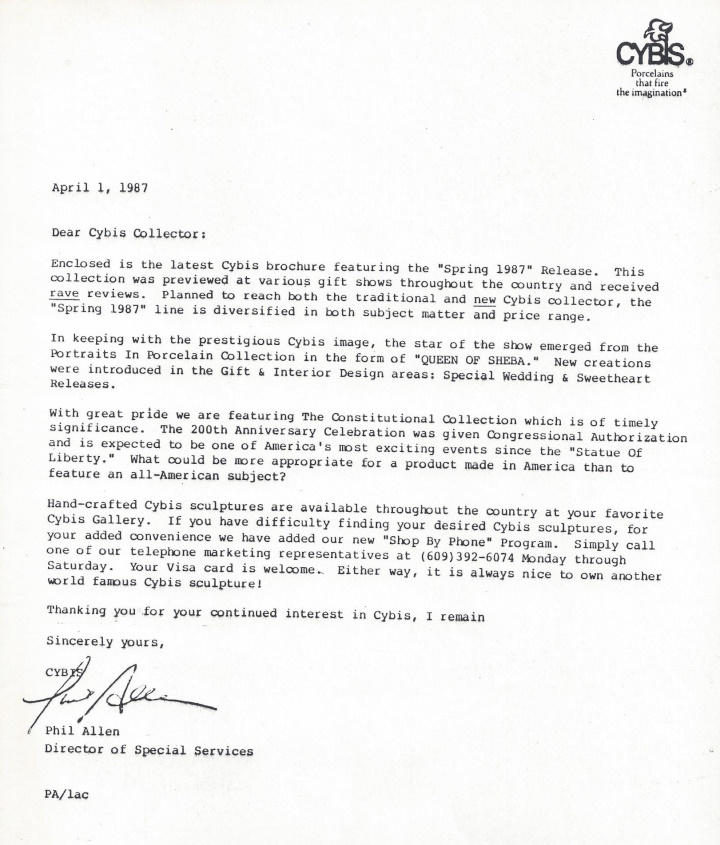 This letter, sent to collectors in April 1987, announces a ‘Shop by Phone’ service whereby people could order directly from the studio. This is something that had never been done before, and coincides with the recent marriage of Joe Chorlton to Theresa Rose, who was then given control of the business end of the studio. This is the first record of the studio ever selling direct-to-consumer on a large scale. Phil Allen, who signed this letter, was previously a colleague of Theresa’s at a local radio station. He was hired on that basis, and his vague, obviously-made-up title (‘Director of Special Services’) reflects that. By this time, the studio had experienced multiple financial difficulties that were not all related to the slackening retail demand.
It is telling that Armstrong’s no longer chose to carry Cybis after the mid-1980s. Brielle Galleries, which had once been the strongest non-studio advertiser for Cybis, gave them only two pages in their Fall 1985/Spring 1986 color catalog.
 Brielle Galleries sounded alarm bells in 1987 with this Urgent Message to its clientele. The phrasing “In light of this short notice” reflects the changing relationship between the studio and some of its retailers, and that Brielle was not happy about the writing that they now saw upon the wall. Ira Jacobson chose to do the right thing and honor the old prices for anything that a customer ordered before September 1st, even though the sculptures might not be delivered until months later and Brielle’s profit margin on those pieces would thus be reduced.
 This is a section of the price list printed by Brielle and sent with the Message mailing. This old/new price comparison was a first for any retailer; they, and Cybis, always assumed that a customer would not bother to compare a sculpture’s price on a newly-received official Cybis price list with its price on the previous one(s.) The fact that Brielle chose to put that information front and center is commendable.
Cybis retailers had already been ranked according to their level of involvement; only those who locked themselves into a contract were considered ‘first tier’ and received perks such as advertising materials from Cybis.
Brielle chose to cut ties with Cybis a few years after this. I had the privilege of reconnecting with Ira Jacobson shortly before his death, and directly asked him if he could tell me the year and reason that he chose to no longer be a Cybis retailer. Being a gentleman, he was evasive but acknowledged that their relationship “did not survive the 1990s.” Their spring 1990 issue of the Quest for Excellence catalog does include the Carousella items which were introduced in 1988 and 1989; but their 1993 catalogs do not contain even one piece of Cybis – although they contain Lladro, Boehm, Herend, Theo Faberge, and the first of a series of ten licensed Disney limited-edition porcelains designed by Carl Barks and made by the British studio Connoisseur of Malvern, priced at $6,950. From all indications, it does appear as though the parting of the ways between Brielle and Cybis happened in 1991 or 1992.
The year 1989 was marketed by the Cybis studio as their Golden Anniversary year, which it was if the count starts in late 1939 which was the year when Boleslaw and Marja Cybis settled permanently in the USA. The actual first studio in Queens probably did not open until early 1940, and the first New Jersey studio didn’t exist until 1942. As the End of the Cybis Studio post relates, the studio laid off all of its employees at the holiday party in December 1989. It reopened in November 1991 without the veteran artists and and artisans who had previously been there. This ushered in an entirely different era in the marketing and retailing of Cybis.
 These public-access events were held late in the year (for holiday shoppers) and on weekends, even though the studio itself was nominally open from 9-5 daily. This ad appeared in a local Princeton NJ newspaper.
Another new strategy was to join the growing factory-tours trend. As an article in the November 11, 1992 issue of The Trentonian relates,
Years ago it would have been almost unthinkable to see tour buses filled with senior citizens, members of civic clubs, and church groups lined up on Norman Avenue waiting to drop off their passengers for a shopping spree/sightseeing tour of the 52-year-old Cybis studios
It also mentions a room featuring “a special gift section that includes pins, earrings and miniature sculptures, ranging from $10 to $100.” (More about those in the next paragraph.) It also comments that “Aside from preparing for what they hope will be a successful holiday sales season, the Chorltons are gearing up for the 100th anniversary of Boleslaw Cybis’ birth.” That occurred in 1995, but I have never been able to find any advertising or literature from that year mentioning anything special being done.
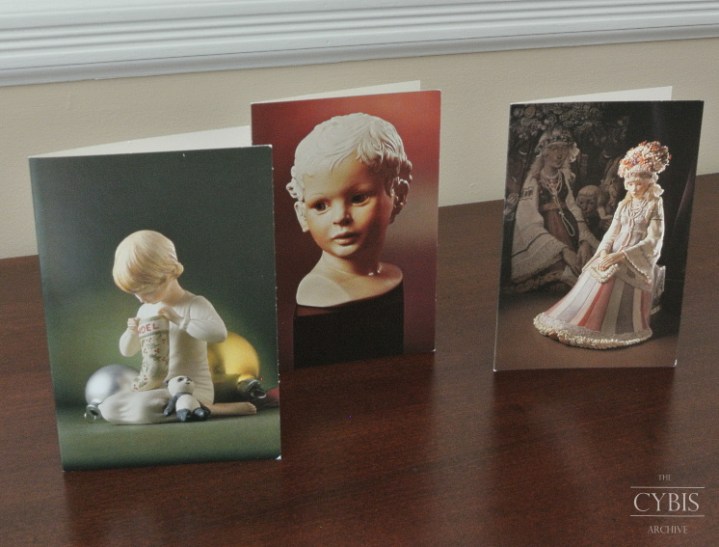
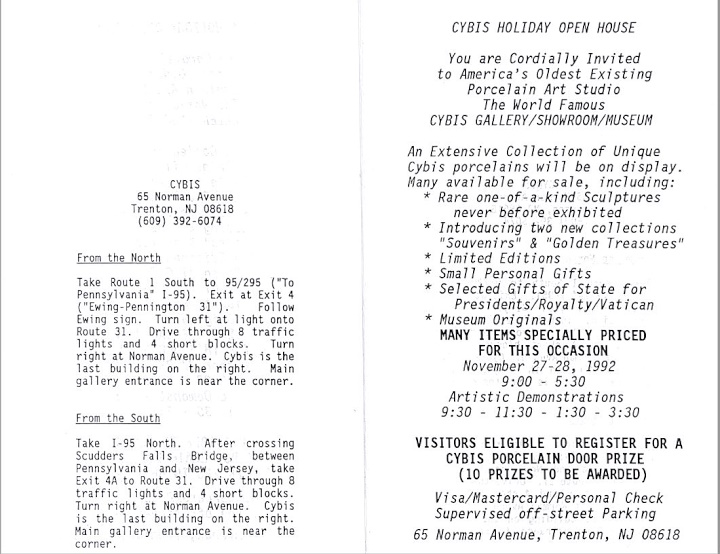 The studio used a local printer to create three styles of greeting cards during the early 1980s, boxes of which were given to special customers and friends. A decade later, the back-stock was used for printing card-style invitations to the annual holiday open house weekend. The two ‘new’ collections (Souvenirs and Golden Treasures) do not appear in any price list that I have, and were only on-site group designations; see The Prince and the Pauper for two items reportedly from ‘Golden Treasures’. The ‘Souvenirs’ category was a catch-all for various small items that were leftover molds or had acted as secondary design elements of previously-closed editions (such as the same basket of two baby chicks that once sat behind Little Jamie or the small fan that both Kitri and Good Queen Anne normally held.) There were numerous such items within many lots in the 2019/2020 studio liquidation auctions.
 The 1994 open-house invite was in the form of a letter instead. It included a sneak peek of the upcoming Cybis Collectors Society to be launched the following year.
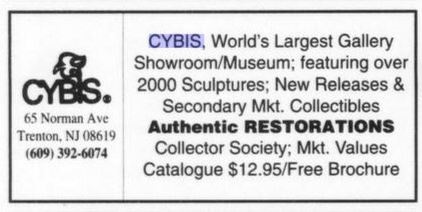 Although Acquire magazine only survived for a few years, a more generalized (and much less high-end) similar publication was called Collector Editions. This survived into the 1990s. Cybis placed this ad in the Classified section of the July/August 1995 issue. Notice that it mentions ‘Authentic Restorations’. During a phone conversation with Theresa Chorlton shortly before launching my Cybis Archive site, I asked her if they were still offering that service and if so, whether she would want to me put that information on my site. Her hesitant reply was that having them do a restoration might be possible, “But if someone says they bought the piece on eBay, we will not even talk to them.”
As the 1990s progressed, most of Cybis’ former retailers had either gone out of business or had chosen to no longer carry Cybis. The market had changed dramatically from the boom years of the 1960s and 1970s.
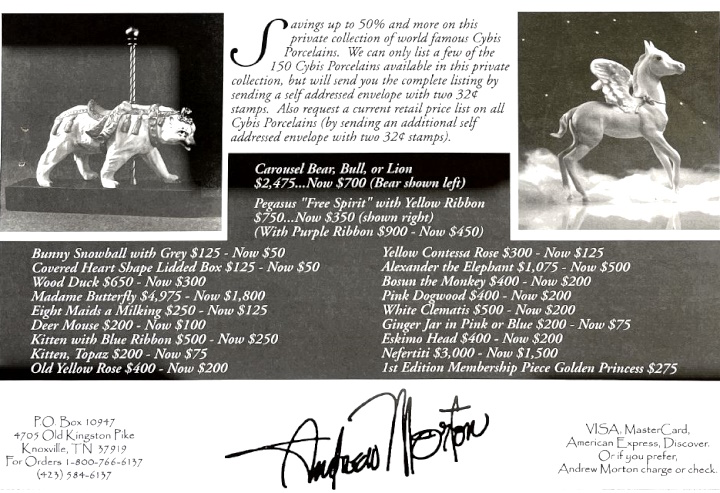
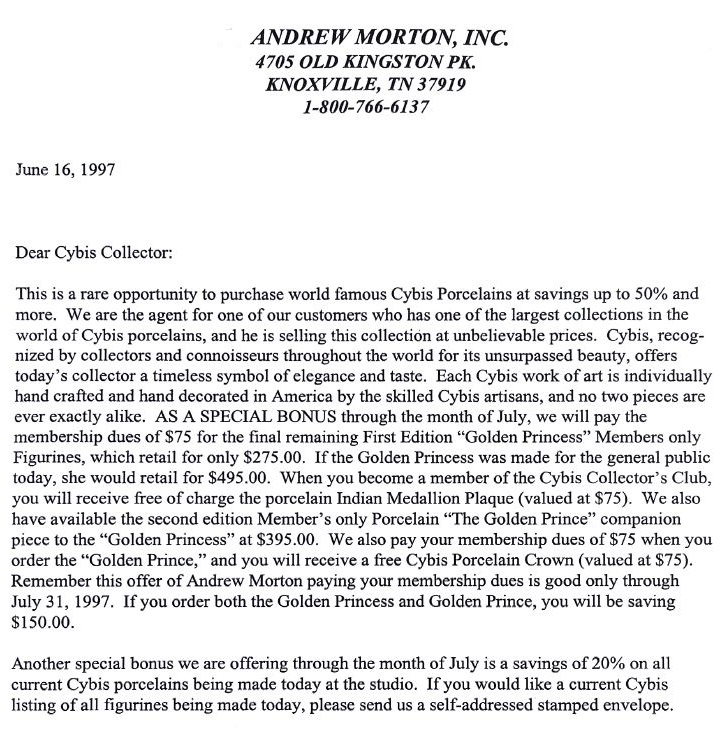 Ads and mailings such as this 1997 one from Andrew Norton Gifts in Tennessee offered heavily discounted prices on Cybis pieces as well as discounts on the recent Collectors Society and a 20% discount on all current Cybis pieces. I had to shake my head over their pricing of ‘Free Spirit’ in setting the yellow-ribbon version at a lower price than the purple – because the yellow-ribbon one (as related here in its own post) is by far the scarcer of the two colorways! Someone at Andrew Norton Gifts did not do their homework.
By 1997, eBay had completely transformed the secondary collectibles market over the past two years. No longer did collectors need to depend on garage and tag sales, or stores that no longer existed (or that no longer carried Cybis), or even the studios themselves for their collecting wants. The studio itself tried selling on eBay for a short time in the early 2000s but it did not work out; buyers were not willing to wait multiple months or even years for an item that they expected to receive in a reasonable amount of time after paying up front for it. Complaints were registered with eBay, and it is likely that the studio’s account was terminated after a few of those.
What Went Wrong?
It would be unfair to lay all of the blame for the Cybis marketing/retailing woes of the 1980s, 1990s, and 2000s on the studio. As related in this post, there were other factors at play, not least being the rise of much-less-expensive mass marketing companies such The Franklin Mint. Such companies debased the term ‘limited edition’ to such an extent that I sometimes wonder whether it has much cachet anymore. But I digress.
The studio did make some serious marketing mistakes during those decades, however. One of them was to alienate the veteran artists who had carried the studio through the boom years, by hiring management staff who had no background in an art-based milieu. Their second mistake was to alienate many of the retailers who remained/survived into the 1990s. Any manufacturer whose product is in high demand can pretty much write their own ticket (and rules) when it comes to their dealings with retailers. But when that demand cools off, well, not so much. Several former retailers and buyers with whom I have spoken have used the terms “high-handed” and “unreasonable” when describing their later dealings with the Cybis studio. The phrase “became impossible to deal with” got thrown around a few times also.
The fact that Cybis was never advertised nationally in major magazines or big-market newspapers after the early- to mid-1980s made matters even worse. It’s possible – perhaps even likely – that the studio did not have the money to do so. Tony Trezza, their new Art/Marketing Director, did the best he could for the first few years but eventually had to admit defeat. His decades in the advertising business made him the one captain who could have kept the Cybis marketing ship afloat, but by the mid-1980s there were already too many holes in the hull.
Although the studio had a website (it was not professionally created, and showed it), there was no mechanism for actually buying online and the item photos ranged from inadequate to non-existent. Shipping costs were a mystery until the item was literally ready to ship, and there’s no indication that even an estimate was provided at the time of payment. Orders were non-cancellable; if you changed your mind or got tired of waiting a ridiculously long time, too bad. The studio never utilized the available early-2000s social media (Twitter, Facebook, or blogging platforms such as Tumblr or WordPress) at all. A search of the NY Times database brings up no advertising by or for Cybis other than occasional appearances in tag and auction sale ads in the Classified Section.
In my opinion, the biggest marketing mistake that Cybis made during their final decades was that of pricing. To put it bluntly, their price increases blindly continued to ‘party like it was 1979’. I have no doubt that the huge circa-1980s and 1990s pricing jumps (for both new and still-in-production editions) were a desperate attempt to control some of their worsening financial problems. But even after the downsizing/restructuring in 1990, the prices never reflected what the actual market value was, or was rapidly becoming. The writing was on the wall, but the Cybis studio management either did not see it or refused to read it. It is all well and good to declare that an item is worth such-and-such a large amount of money, but one must have the hard numbers of actual sales to back that claim up. Without that data, the statement becomes no more than a matter of opinion.
Occasionally I speculate about whether things might have turned out differently, had the studio’s marketing strategy been different. We need only look at that heat-seeking missile of marketing opportunity, Helen Boehm, for proof that it could be done (although the ultimate result of ‘no more studio’ was the same for both.) At least Cybis never lowered itself to partnering with mass-market importers or producing ‘collector plates’ in editions of multiple thousands, or a dinnerware pattern – all of which the Boehm studio did. Nevertheless, Cybis could have done better and adapted to the changing world, especially in the areas of digital marketing and reality-based price points. Even after their retailers of yesteryear were no more, a new marketing path existed. It’s a shame that the Cybis studio didn’t take it.
Name Index of Cybis Sculptures
Visual Index (for human figures/busts only)
About the Cybis Reference Archive
What is Cybis?
Images of Cybis porcelains are provided for informational and educational purposes only. All photographs are copyrighted by their owner as indicated via watermark and are used here only as reference material. Please see the Copyright Notice in the footer and sidebar for important information regarding the text that appears within this website.
The Cybis Archive is a continually-updated website that provides the most comprehensive range of information about Cybis within a single source. It is not and never has been part of the Cybis Porcelain studio, which is no longer in business.
 THE CYBIS ARCHIVE