
As the Art Director of the Cybis porcelain studio for more than a dozen years, George Ivers had almost as much influence over its artistic history as did Marylin Chorlton and Laszlo Ispanky. However, the scope of his work was far wider than many suppose, and spanned an active career of more than six decades.
Even after paring down this retrospective – which was no easy task, given the quality and quantity of examples! – it still felt too large for a single Archive post and so I have divided it into three parts. This first overview contains a biography in timeline format and a gallery of his known Cybis items. Part Two covers only the art that he created as a result of his time as a POW during World War II. Part Three looks at his non-Cybis paintings on porcelain, painted porcelain jewelry, original oil and watercolor paintings, limited-edition prints, and the greeting cards that he designed during the 1970s and 1980s.
A Timeline of the Life of George Ivers
The dates in this timeline are taken from a letter that Ivers wrote during the early 1980s to the United Nations Children’s Fund (UNICEF) in response to their request for a short biography.
 July 5, 1922: born Jerzy Iwaszkiewicz [pronounced eevash-KYE-vytsh] in Zielęcin, Poland. His father Jan and mother Zofia were teachers at the local school. Reportedly, his interest in art began at about age 5. This photograph was taken in the early 1930s, when George was 10 or 11 years old.
 1939: joins the Polish Merchant Marine as an ensign and is assigned his training cruise on the maiden voyage of the MS Chrobry merchant vessel. When Poland is invaded shortly thereafter, he is stranded in Brazil but eventually makes his way to England and, from there, to the continent.
early 1940: joins the First Polish Grenadiers division in northern France. They are attacked by the Germans at the Maginot Line in what is known as the Battle of France on June 21st, during which he is taken prisoner and sent to the Weissenburg POW camp (Stalag 5D), where he remains for more than a year.
October 25, 1941: escapes from the Weissenburg camp during a ditch-digging detail and makes his way to Switzerland. From there he goes to France and heads toward Gibraltar. He is captured in Spain by the Spanish police on the orders of Spain’s General Franco who was a supporter of Hitler, and is sent to a concentration camp at Miranda del Ebro.
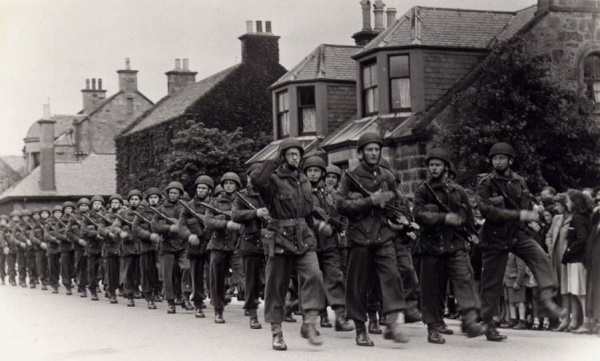 1943: goes on a hunger strike and is eventually released via the efforts of the Red Cross. Eventually arrives in England, enlists in the 1st Polish Army Corps and is sent to Scotland to assist with coastal defenses.
1944-1945: leaves the Army Corps and rejoins the Polish Merchant Marines, assigned to convoys for the Allied invasion of Europe.
 1946: learns that if he joins the U.S. Army he will automatically receive citizenship upon discharge, but is unable to leave his ship in order to enlist. He deliberately causes himself to become so ill that he requires transfer to a hospital in NY City; upon recovery he joins the U.S. Army and meets his future first wife Phyllis (also known as Terri) Schiff in September at a USO show.
1947: He is sent to Korea, after which tour of duty he is honorably discharged.
1948: moves to the Bronx, NY, and enrolls as a student at the Art Students League of NY.
 January 1949: marries Phyllis-Terri and is hired by the Royal Jackson China Company in Westchester, NY. The couple eventually has three children (two boys and a girl.) The photo above is his Royal Jackson pattern design Enchantment.
1950: receives American citizenship based on his US Army service.
1952: legally changes his name from Jerzy Iwaszkiewicz to George Ivers.
1958: is hired by the Lenox China Company in Trenton as a designer; moves to Levittown, PA and later to Morrisville PA; continues art studies at the Pennsylvania Academy of Fine Arts and does freelance work. At Lenox, George works in the same department as Harry Burger who designed a number of Cybis pieces as a freelancer also.
1969: his painting Sunday with Snow and Ice (a/k/a Snowy Sunday) is selected by UNICEF for their 1970 holiday card collection; continues freelance work.
1970: is commissioned by Mary Roebling to create a birthday gift (a porcelain triptych titled Egg Rolling on the White House Lawn) for First Lady Patricia Nixon, which is presented to her a week before that event. That year was the first at which a costumed Easter Bunny appeared at the egg rolling; it’s not known whether the bunny appears in the Ivers work! The Cybis porcelain studio commissions him to create a series of small paintings on porcelain fragments.
1971: Cybis introduces the first series of Limnettes which, in a radical departure from their usual procedure, have Ivers’ name on them as the artist.
 1972: his Lenox china pattern Moonspun (above) is their best-selling pattern for the second year in a row; he illustrates a children’s book, The Pony Who Wanted to Pull the Stage.
1973: is hired by Cybis as their Art Director.
1976: separates from wife Phyllis-Terri and is later divorced.
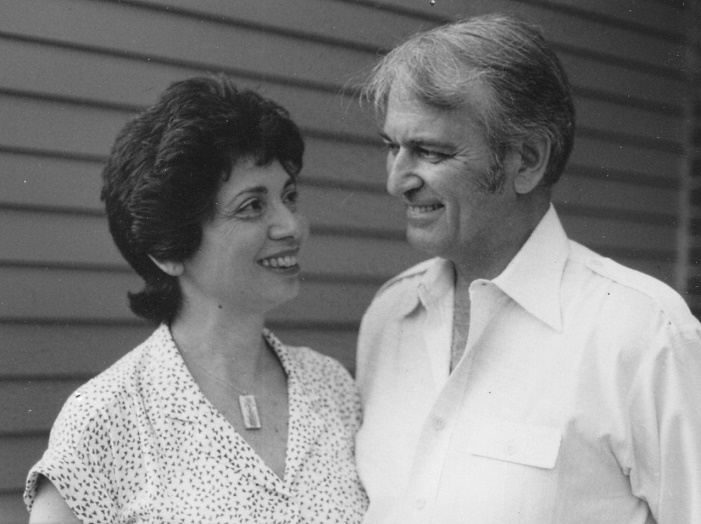 1980: marries Iris Frumkin Herman, a copy editor at Sports Illustrated and buys a home in East Windsor, NJ. She is the love of his life and, from now on, almost all of his art will include an iris flower somewhere.
 1981: is diagnosed with Parkinson’s Disease at age 59 but continues to work at Cybis. This photo was taken at a Cybis event at Brielle Galleries in June 1982, as he demonstrates working on a Persephone.
1986: retires from the Cybis studio.
1987: he and Iris vacation in Mexico, and relocate to Cranbury, NJ.
1990: is commissioned by the Chopin Singing Society to create a gift for Pope John Paul II, a miniature of Saint George carrying a Polish solidarity banner.
1992: is named Man of the Year by the Concordia Chapter of the B’nai Brith.
 1993: publishes his wartime memoir, Escape into Danger, a 242-page softcover book.
 1999: enters the Merwick Rehabilitation Center at Princeton University Medical Center.
 May 8, 2001: dies of complications of Parkinson’s Disease at the age of 78. He continued to paint, using wrist weights to help stabilize the tremors in his hands, until very shortly before his death.
George Ivers Designs for Cybis Porcelain
The Cybis pieces known to have been designed by Ivers are shown in chronological order by introduction year; some of them were never formal retail releases but are known to have been his.
 The earliest known Ivers design for Cybis were the Limnettes, designed shortly before he was hired by the studio as their Art Director. There were three limited-edition series of four designs per series. The decorated porcelain molds were mounted on wedge-shaped blocks made of either porcelain or wood. Introduced during 1971 and 1972, they have their own Archive post with detailed information and additional photographs.

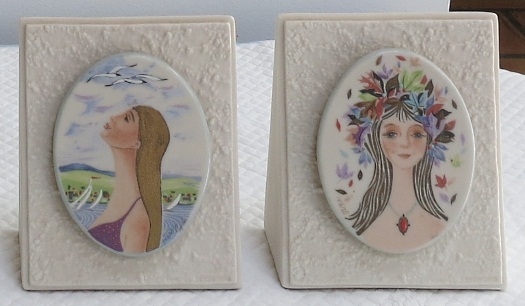 “The Wonderful Seasons” series: Winter, Spring, Summer, and Autumn. These examples are mounted on the porcelain wedges.
 The “Everyone’s Fun Time” series: The Pond, Country Fair, The Seashore, and Windy Day. These examples are on the wood wedges.
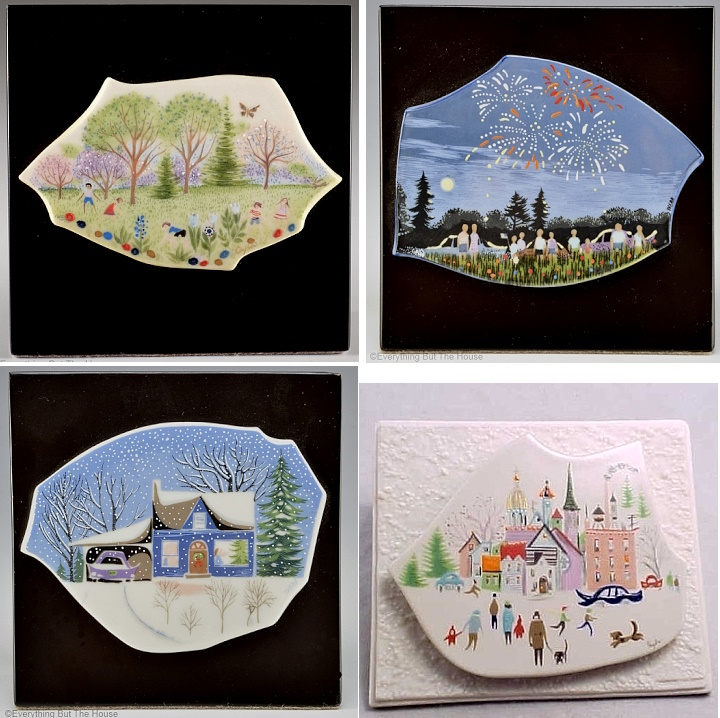 “When Bells Are Ringing” series of holidays: Easter Egg Hunt, Independence Celebration, Merry Christmas, and Sabbath Morning.
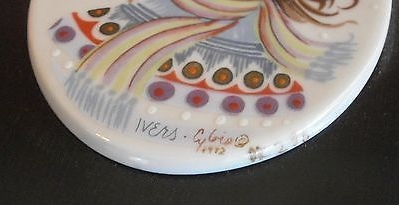 The name Ivers appears within each Limnette design along with the painted Cybis signature. The only other Cybis retail product that ever bore an artist’s name was the limited edition Nashua in 1971; it was a condition of Cybis being allowed to create that sculpture based on that artist’s painting.
Four biblical-tales porcelain sculptures were in the 2019/2020 Cybis studio liquidation lots. They were made during the early 1970s and have their own Archive post. Their titles are my own inventions based on appearance.
 Noah on Driftwood and Moses on Rock
 Jonah on Wave and Adam and Eve on Tree
 This sample plate, hand-dated November 1973 on the reverse, shows the four sculpture designs applied as a transfer decal. It is probably one of a kind.
George Ivers absolutely loved doing fine detail work and, as you examine the following items that he created for Cybis, I am sure you will be struck by how certain design elements such as textured backgrounds, organic shapes and curves, and jewel-like accents repeatedly occur. These were all open (non-limited) editions except for The Bride.
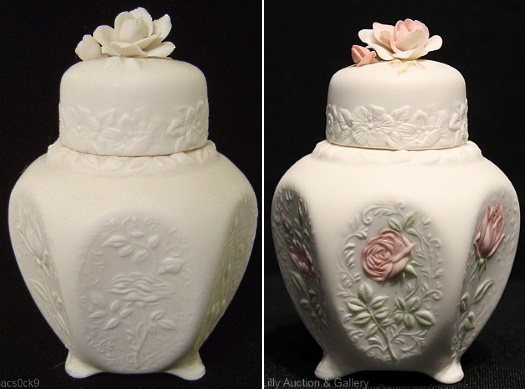 Rose Jar, an open edition produced in 1975, 1976 and 1977 in two color options.
 This one-of-a-kind turtle (as explained here, his name is now Kermit), painted and signed by George Ivers in 1974, was given to me by a Cybis artist.
 The 1975 open edition Turtle ‘The Baron’ is a modified Kermit. I recently discovered that the frog is not an original design; it was cast from a mold made from an existing tiny bronze(?) frog.
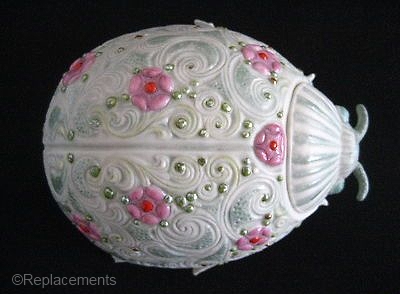 Another in the new 1975-1977 ‘Caprice’ collection was Ladybug ‘Duchess of Seven Rosettes.’

 Marigold and companion piece Tiffin, from 1977. It’s not known whether George Ivers designed the fairies as well as the decorations on the turtle and frog.
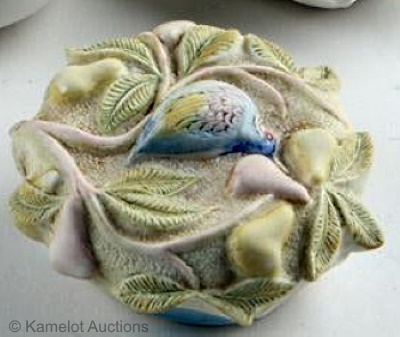
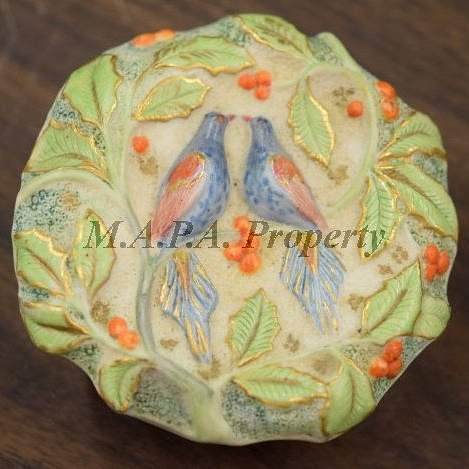
 These circa-late-1970s ‘twelve days of Christmas’ paperweights were identified by Lynn Klockner Brown as being George Ivers’ work. These examples are the Partridge in a Pear Tree, Two Turtle Doves and Three French Hens. George made them to give to co-workers and friends, although during the 1990s and 2000s the studio took some of the molds and painted them in single colors for their ‘Souvenirs’ display section to tour bus visitors. The ‘Souvenir’ items were small and sold for under $100 each.
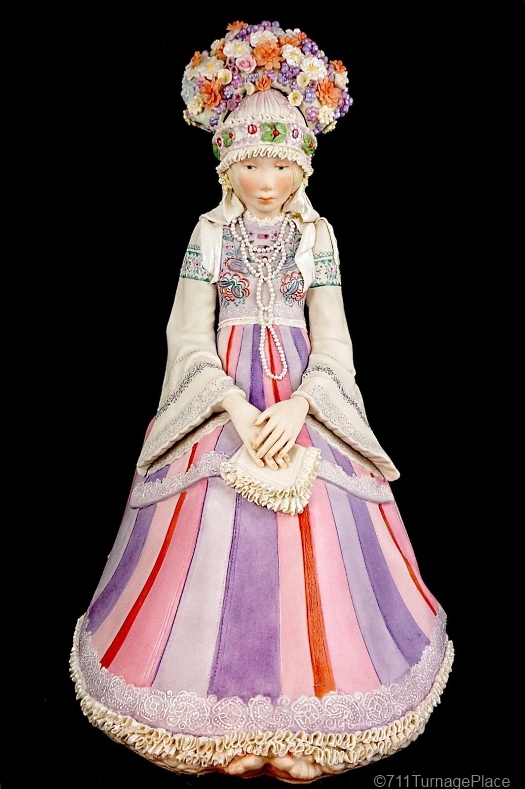 One of the most impressive examples of detail work was surely The Bride, a limited edition of 100 in 1980. The sculpture itself was not modelled by Ivers, nor were the handmade flowers, but he sculpted the intricate decorations on her clothing, bridal chest, and headdress which all needed to match the original circa-1930s Boleslaw Cybis painting. See more photos and background about ‘The Polish Bride’ in her own post.
 Ariel (1981) rides a George Ivers grasshopper.
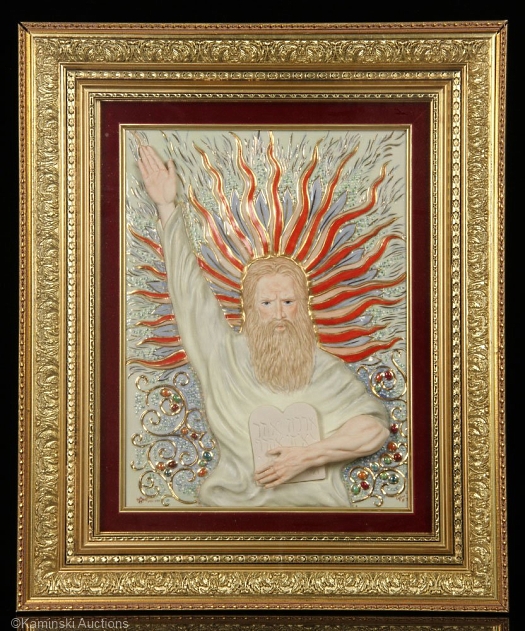
 George Ivers designed (and often painted) the 1981 limited-edition dimensional Moses Plaque and Holy Child of Prague Plaque. Both of them can be seen in more detail in the Plates and Plaques post. Freelance illustrator Cyndy Bohonovsky told me of watching Ivers work on a Moses Plaque as she sat nearby while creating her own watercolor version of it which can be seen in the aforementioned Archive post. The plaques were editions of 25 each.
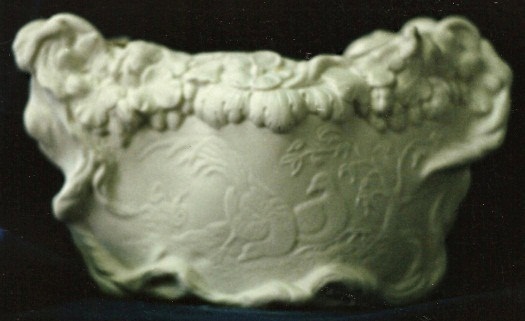 This prototype cachepot dates from the early 1980s and was a collaborative effort by George Ivers and in-house artist Steve Zuczek. This may possibly have been released during the mid-1990s as the Eden Bowl which was reportedly 5.5″ high and 9.5″ wide. I have never found a photo of that retail piece, but there certainly are enough botanical elements in this prototype item to qualify as a garden!
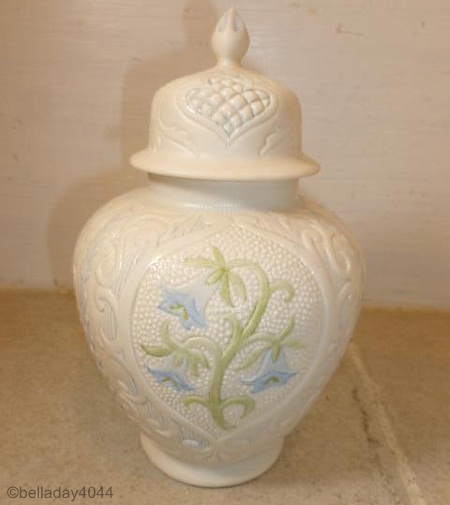 The Virginia Bluebells Ginger Jar has a copyright year of 1983 in the mold.
 The 1983 Bacchus Vase/Carafe has a flower motif on the back side which is – you guessed it – an iris.
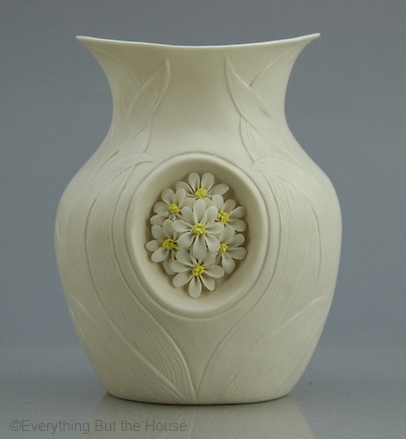 The Daisy Vase was also introduced in 1983.
 The four Annual Decorative Eggs (1983-1986) were designed by Ivers. They are shown in more detail in the Decorative Eggs post, including the specially designed box that they came in.
 The Iris Compote appeared in 1983; it is 5” high and 7” in diameter. Was the lady’s face modelled on Iris Ivers?
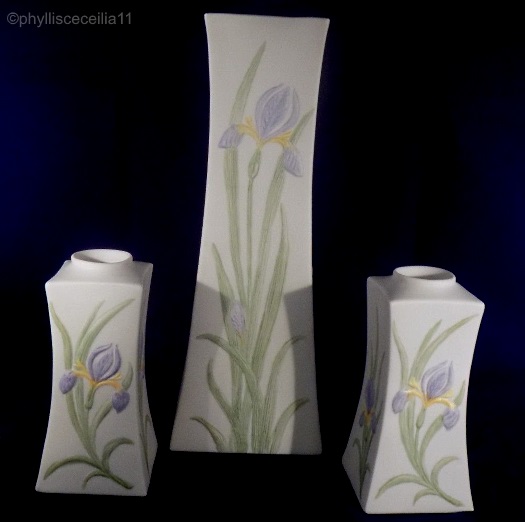
 The Iris Candlesticks and Iris Vase, as well as the Iris Pedestal Dish, were introduced in 1984 and made for only a few years.
 This Unicorn Vase was in the liquidation auctions and never was, to my knowledge, a retail offering. It is an almost exact representation of one of George Ivers’ paintings, and of course incorporates an iris flower (a yellow one at the lower center beneath the unicorn.)
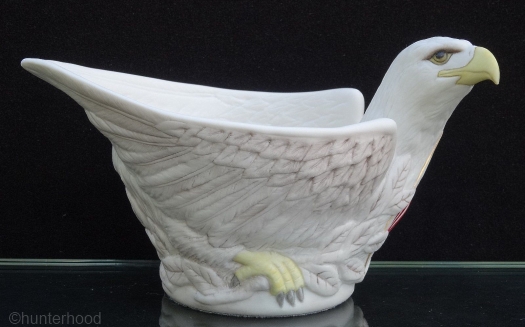
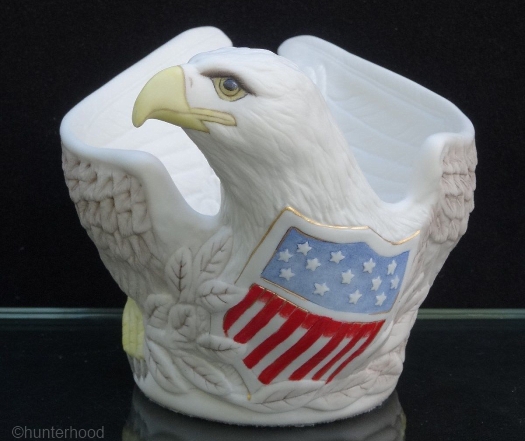 The Eagle Bowl, appearing in 1987 as part of the studio’s Constitutional Collection, was another Ivers/Zuczek collaboration.
 For the 1987 Cupid with Heart, George Ivers designed the heart and foliage; Lynn Klockner Brown created the cupid, but the finished product differs from her original design in the wings, hands and fingers.
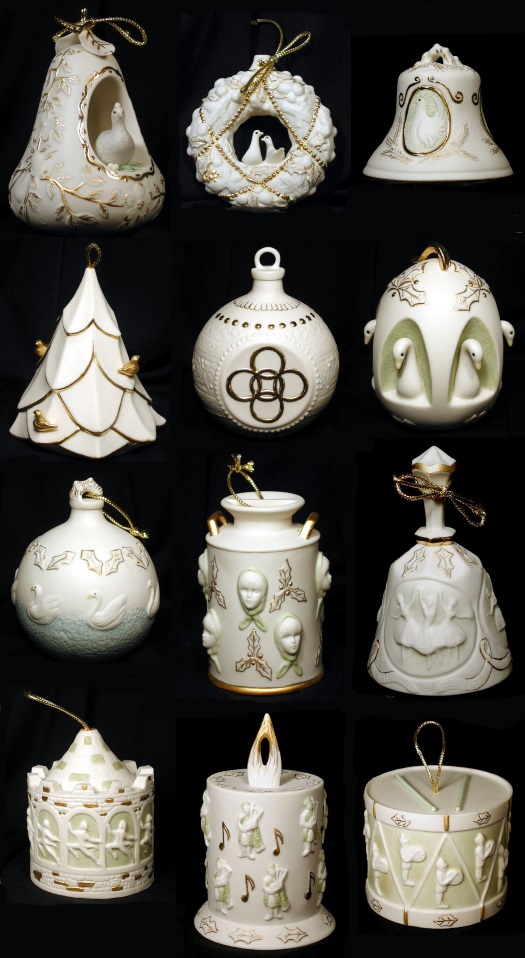 Although the launch of the Twelve Days of Christmas holiday ornament series did not occur until 1989, the set was definitely designed during the early 1980s and – in my humble opinion – probably by George Ivers.


 It is possible that the 1984 Reindeer Ornament was designed by him as well. The third photo is the circa-early-2000s Partridge Ball Ornament which is the exact same mold but with a different central motif (and is damaged).
The next part of my George Ivers profile examines some of his wartime and wartime-related art, and his published memoir of his wartime experiences.
Name Index of Cybis Sculptures
Visual Index (for human figures/busts only)
About the Cybis Reference Archive
What is Cybis?
Images of Cybis porcelains are provided for informational and educational purposes only. All photographs are copyrighted by their owner as indicated via watermark and are used here only as reference material. Please see the Copyright Notice in the footer and sidebar for important information regarding the text that appears within this website.
The Cybis Archive is a continually-updated website that provides the most comprehensive range of information about Cybis within a single source. It is not and never has been part of the Cybis Porcelain studio, which is no longer in business.
 THE CYBIS ARCHIVE